
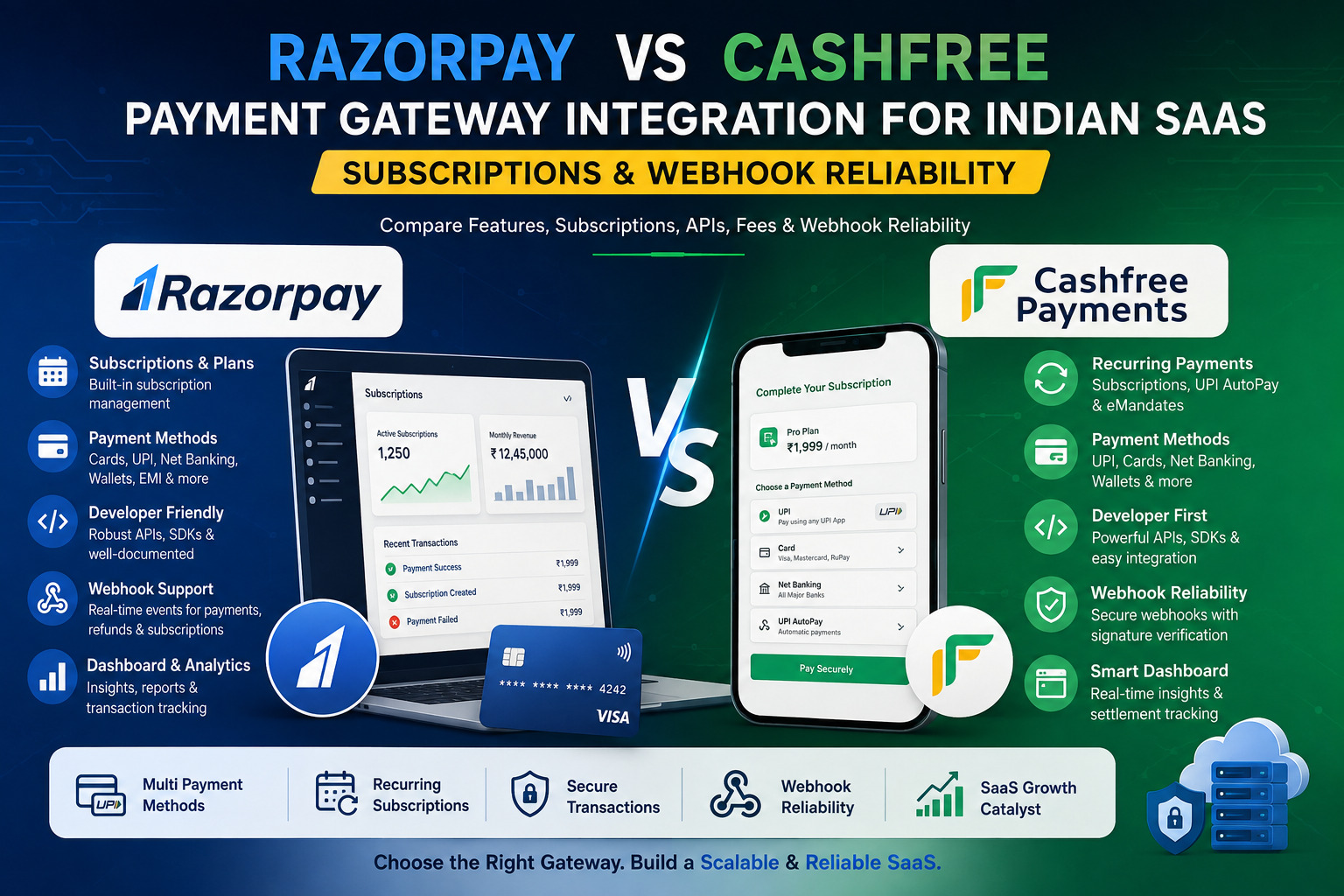
Payment Gateway Integration for Indian SaaS: Razorpay vs Cashfree, Subscriptions and Webhook Reliability
Introduction
For an Indian SaaS business, choosing a payment gateway is about much more than accepting a customer's first payment. Subscription-based businesses need reliable recurring payments, payment status synchronization, mandate management, refunds, payment retries, webhook processing, reconciliation, and secure billing workflows. Razorpay and Cashfree are two widely considered payment gateway options for businesses operating in India. Both provide APIs, payment processing capabilities, recurring payment solutions, and webhook-based integrations. However, the right choice depends on your subscription model, payment methods, technical architecture, customer base, transaction volume, and business requirements. Businesses investing in Web Development Services and Digital Transformation Services should treat payment infrastructure as a critical part of their overall SaaS architecture.
Why Payment Gateway Selection Matters for SaaS Businesses
A traditional e-commerce transaction is relatively simple: a customer selects a product, completes payment, and receives an order confirmation. SaaS billing is more complex because the relationship continues after the initial transaction. A SaaS platform must manage subscription creation, recurring charges, payment failures, renewals, cancellations, refunds, plan upgrades, downgrades, and customer access. A payment gateway therefore becomes a core component of the revenue infrastructure rather than simply a checkout tool.
Razorpay vs Cashfree: An Overview
Razorpay and Cashfree both provide payment gateway solutions for businesses in India. They support common online payment methods and provide developer APIs, checkout experiences, dashboards, and webhook-based integrations. For SaaS companies, both platforms can be evaluated based on payment method coverage, recurring payment capabilities, API flexibility, webhook handling, settlement requirements, integration complexity, customer support, and commercial terms. Instead of selecting a gateway based only on transaction fees, SaaS businesses should evaluate how well the gateway fits their complete billing lifecycle.
Razorpay for SaaS Businesses
Razorpay provides payment processing and subscription capabilities that can be integrated into SaaS applications through APIs and checkout experiences. SaaS businesses can use Razorpay to manage payment collection and recurring billing workflows while connecting payment events to their own backend systems. A typical integration involves creating a subscription or payment request, collecting authorization from the customer, processing recurring payments, receiving webhook events, and updating the application's subscription status. Businesses developing custom SaaS platforms through Web Development Services can integrate Razorpay into their application architecture based on their billing requirements.
Cashfree for SaaS Businesses
Cashfree provides payment gateway and recurring payment capabilities designed for businesses that need online payment collection and subscription-based billing. Its payment ecosystem supports multiple payment methods and recurring payment mechanisms, making it an option for SaaS companies that want to support Indian payment preferences. Cashfree also provides APIs, checkout options, subscription workflows, and webhooks that can be integrated into custom SaaS applications. Businesses can evaluate Cashfree based on their payment mix, recurring billing requirements, integration approach, and expected transaction volume.
How Subscription Payments Work in a SaaS Application
A SaaS subscription payment involves several stages rather than a single transaction. A typical flow begins when a customer selects a subscription plan. The application then creates the required payment or subscription request through the gateway. The customer completes payment or authorizes a recurring mandate. The payment gateway processes the transaction and sends an event to the SaaS backend through a webhook. The backend verifies the event, updates the subscription record, and grants or continues access to the customer. This architecture ensures that billing status and application access remain synchronized.
Recurring Payments for Indian SaaS
Recurring payments are one of the most important considerations for SaaS businesses. Unlike one-time purchases, subscriptions require a payment method or mandate that can be used for future billing cycles. Indian SaaS businesses should evaluate support for recurring card payments, UPI-based recurring payments, e-mandates, payment retries, failed payment handling, and customer notifications. The ideal payment method depends on the subscription value, customer segment, billing frequency, and payment preferences of the target audience.
Razorpay vs Cashfree for SaaS Subscriptions
Both Razorpay and Cashfree can be considered for recurring SaaS payments, but the best option depends on the business's specific requirements. Razorpay can be suitable for businesses already using its payment ecosystem and looking for integrated payment and subscription capabilities. Cashfree can be attractive for businesses that prioritize a broad Indian payment ecosystem and recurring payment options such as UPI-based mandates. Before selecting a provider, businesses should verify the currently supported payment methods, recurring payment limits, pricing, settlement timelines, and merchant eligibility for their specific account.
Why Webhooks Matter More Than the Payment Success Page
One of the most important concepts in SaaS payment integration is webhook processing. A frontend payment-success page should never be treated as the final source of truth for subscription activation. A customer may complete a payment while the browser closes, the network fails, or the frontend request is interrupted. Webhooks allow the payment gateway to notify the backend about payment and subscription events. The backend can then verify the event, update the database, and synchronize customer access. Businesses building reliable payment systems should implement webhook processing as a core backend service.
Webhook Reliability: What SaaS Companies Should Measure
Webhook reliability is not simply about whether a payment gateway provides webhooks. SaaS businesses should evaluate how their own systems process those events. A reliable webhook architecture should include signature verification, idempotency, retry handling, event logging, error monitoring, and reconciliation. Signature verification helps ensure that incoming events are authentic. Idempotency prevents the same event from creating duplicate transactions or subscription updates. Logging makes failures easier to investigate, while reconciliation provides an additional mechanism for detecting differences between the payment gateway and the SaaS database.
Webhook Signature Verification and Security
Payment webhooks should be treated as security-sensitive backend events. Your application should verify the webhook signature before processing payment information or changing a customer's subscription status. The webhook endpoint should also use HTTPS, validate required fields, reject malformed requests, and prevent unauthorized access. Sensitive credentials such as API keys and webhook secrets should never be stored directly in frontend code. Businesses implementing secure payment applications should include security as part of their Cloud Services & Infrastructure and application architecture.
Why Idempotency Is Critical for Payment Webhooks
Payment providers may send an event more than once, and network or application failures can result in repeated processing attempts. If a SaaS application does not handle duplicate events correctly, it could activate a subscription twice, create duplicate invoices, or incorrectly update a customer's account. Idempotent processing means the application identifies an event that has already been processed and safely ignores the duplicate. A common implementation stores a unique event or transaction identifier in the database before completing the business operation.
Handling Failed Subscription Payments
A failed recurring payment should not automatically result in immediate account termination. SaaS platforms should define a clear payment failure strategy that may include retry attempts, grace periods, customer notifications, payment-method updates, and eventual subscription suspension. The exact workflow depends on the business model. A robust billing architecture should separate payment status from application access rules so that the system can respond intelligently to temporary payment failures.
Why Payment Reconciliation Is Essential
Webhooks are an important part of payment integration, but SaaS businesses should not rely on them as the only mechanism for maintaining billing accuracy. A reconciliation process can periodically compare payment gateway records with the application's subscription and transaction database. If a payment event was missed because of downtime or an integration failure, reconciliation can identify the mismatch and allow the system to correct the customer's billing status. This becomes increasingly important as transaction volumes grow.
Razorpay vs Cashfree: Look Beyond Transaction Fees
Payment gateway selection should not be based only on the advertised transaction fee. SaaS companies should consider the total cost of payment infrastructure, including transaction charges, applicable taxes, settlement requirements, recurring payment capabilities, refunds, international payments, operational overhead, engineering effort, and support. Pricing and promotional offers can change over time, so businesses should always verify the current commercial terms directly with the payment provider before making a final decision.
Developer Experience and API Integration
For SaaS businesses, developer experience can significantly affect implementation time and long-term maintenance. Engineering teams should evaluate API documentation, SDK availability, checkout customization, subscription APIs, webhook documentation, sandbox environments, error handling, testing tools, dashboard capabilities, and technical support. A gateway that is easy to integrate but difficult to troubleshoot can create operational problems later. Businesses building custom SaaS products through Web Development Services should evaluate the complete developer experience before selecting a payment provider.
Where Does Chargebee Fit Into the Architecture?
SaaS businesses using a billing platform such as Chargebee should distinguish between subscription management and payment processing. A billing platform can manage plans, subscriptions, invoices, customer billing information, and subscription lifecycle logic, while a payment gateway processes the actual payment. This creates an architecture where the SaaS application communicates with the billing layer, and the billing layer integrates with the payment gateway. For businesses such as B6AI, this separation can simplify subscription management while allowing payment infrastructure to remain modular.
Recommended Payment Architecture for Indian SaaS
A scalable SaaS payment architecture can include the customer-facing application, a billing or subscription service, the selected payment gateway, a dedicated webhook service, and a reconciliation process. The frontend should initiate subscription actions, while the backend handles payment creation, verification, webhook processing, subscription state changes, and access control. Payment events should be stored with unique identifiers and processing status.
Common Payment Gateway Integration Mistakes
1. Activating subscriptions based only on frontend payment responses.
2. Not verifying webhook signatures.
3. Processing duplicate webhook events.
4. Storing payment credentials in frontend code.
5. Not implementing payment retry and grace-period logic.
6. Ignoring reconciliation between the gateway and internal database.
7. Hardcoding gateway-specific logic throughout the application.
8. Not monitoring failed webhook deliveries.
9. Not testing failed payments and subscription renewals.
10. Choosing a gateway based only on transaction fees instead of total business requirements.
How to Choose Between Razorpay and Cashfree
There is no universal winner between Razorpay and Cashfree for every SaaS business. Razorpay may be a strong fit for businesses that want its payment ecosystem and subscription capabilities, while Cashfree may be attractive for businesses that prioritize Indian payment methods and recurring payment options. The decision should consider the target customer base, subscription pricing, payment methods, recurring billing requirements, API capabilities, webhook architecture, settlement requirements, transaction volume, international payment needs, support, and commercial terms. The best gateway is the one that fits the complete revenue architecture of the business rather than simply offering the lowest headline fee.
The Future of SaaS Payments in India
Indian SaaS payment infrastructure is moving toward more automated and intelligent billing experiences. Recurring UPI mandates, automated payment retries, payment intelligence, fraud detection, reconciliation, and multi-gateway architectures are becoming increasingly important as subscription businesses scale. The future of SaaS payments is not simply about processing transactions—it is about building reliable revenue infrastructure that connects billing, payments, customer access, finance, and business analytics.
Conclusion
For Indian SaaS businesses, choosing between Razorpay and Cashfree is not simply a matter of comparing payment gateway fees. The right solution needs to support the complete subscription lifecycle, including initial checkout, recurring payments, payment failures, webhooks, refunds, reconciliation, and customer access management. Both platforms provide APIs, payment processing capabilities, recurring payment options, and webhook-based integrations, but the ideal choice depends on the SaaS company's payment mix, customer base, subscription model, technical requirements, and commercial terms. A reliable SaaS payment architecture should combine the selected gateway with secure webhook processing, idempotency, monitoring, retry handling, reconciliation, and a well-designed subscription management layer.