
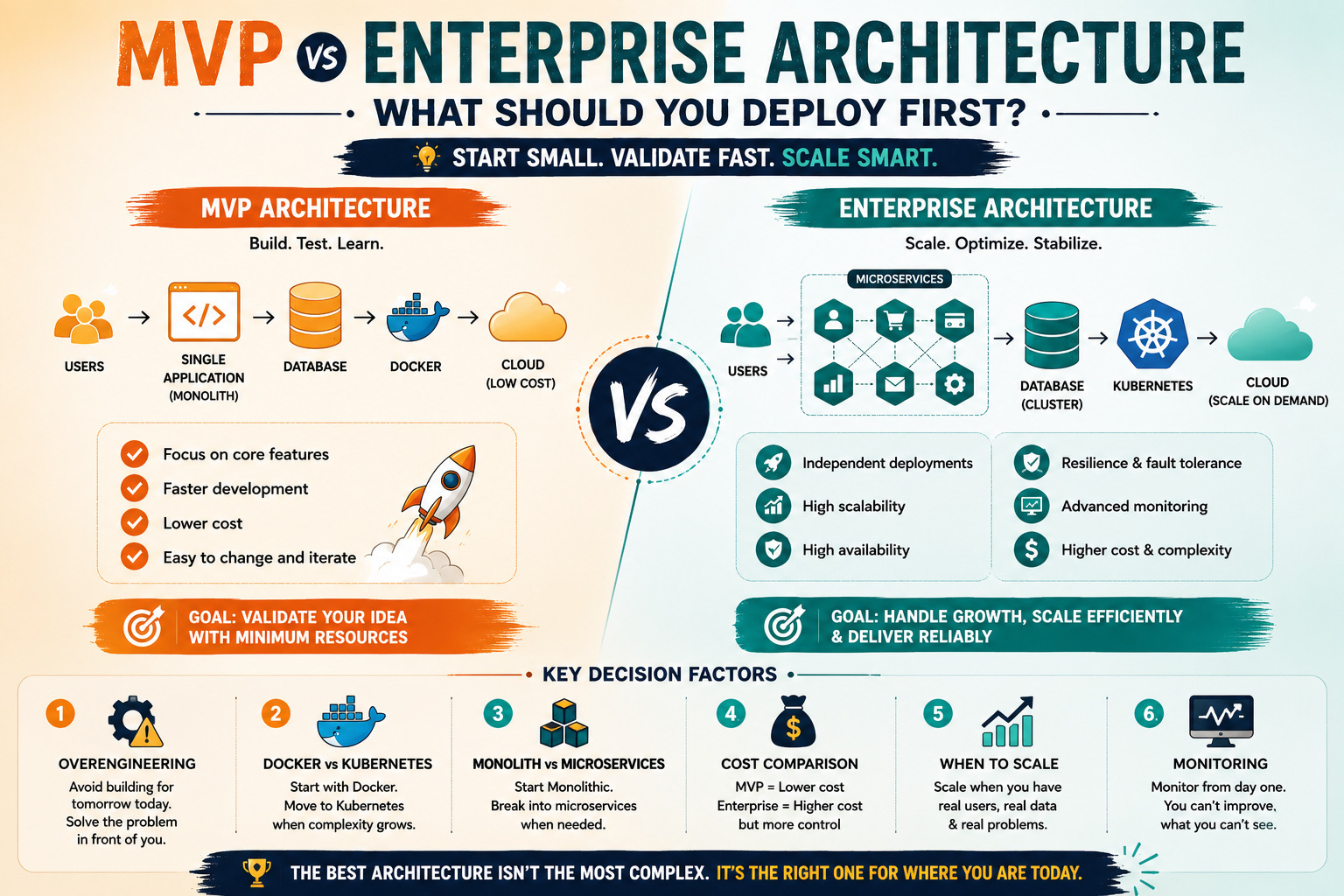
MVP vs Enterprise Architecture: What Should You Deploy First?
Introduction
Every startup dreams of building the next unicorn, but one of the biggest mistakes early-stage companies make is designing software like a billion-dollar enterprise before validating their product. Should you build a monolithic application or adopt microservices? Is Kubernetes necessary from day one, or is Docker enough? How much infrastructure should you deploy before acquiring your first customers? These questions influence development speed, operational costs, scalability, and long-term success. Organizations investing in web development and digital transformation services must understand the trade-offs between building for today and preparing for tomorrow. This guide explores the differences between MVP and enterprise architecture, helping businesses choose the right technology stack at the right stage of growth.
What Is an MVP Architecture?
A Minimum Viable Product (MVP) focuses on delivering the smallest set of features required to validate a business idea. The primary objective is speed, customer feedback, and market validation—not perfect architecture. MVP systems prioritize rapid development, lower costs, and fast iteration.
What Is Enterprise Architecture?
Enterprise architecture is designed for mature businesses handling large-scale traffic, multiple development teams, complex integrations, high availability, security, and regulatory compliance. It emphasizes scalability, maintainability, and operational resilience over rapid delivery.
The Cost of Overengineering
One of the most common mistakes startups make is adopting enterprise-level technologies before they are needed. Building microservices, deploying Kubernetes clusters, implementing distributed databases, and managing complex DevOps pipelines can dramatically increase costs and development time. Overengineering often delays product launches without delivering immediate business value.
Docker vs Kubernetes: What Should You Start With?
Docker is an excellent choice for MVPs because it simplifies application packaging, deployment, and consistency across environments. Kubernetes becomes valuable when applications require automated scaling, self-healing, rolling deployments, and orchestration across multiple services. For most startups, Docker provides everything needed during the early stages, while Kubernetes becomes relevant as traffic and infrastructure complexity grow.
Monolith vs Microservices
Monolithic applications allow faster development, simpler deployments, and easier debugging. They are ideal for startups with small development teams. Microservices provide greater scalability and independent service deployments but introduce additional operational complexity. Most successful technology companies—including Amazon, Netflix, and Uber—started with monolithic architectures before gradually evolving toward microservices.
Cost Comparison: MVP vs Enterprise Infrastructure
MVP architectures typically require fewer cloud resources, simpler deployment pipelines, and lower operational costs. Enterprise architectures involve higher expenses related to orchestration platforms, monitoring, observability, security, networking, and infrastructure management. Startups should optimize for learning and customer acquisition rather than infrastructure sophistication.
When Should You Scale Your Architecture?
Scaling should be driven by measurable business needs rather than assumptions. Indicators include increasing user traffic, growing engineering teams, frequent deployment bottlenecks, and rising infrastructure demands. Organizations working with bespoke solutions can gradually evolve their architecture as business complexity increases.
Monitoring and Observability from Day One
Although startups don't need enterprise-scale infrastructure immediately, monitoring should never be ignored. Basic logging, application performance monitoring, uptime alerts, and error tracking help teams identify issues before they impact users. Investing in observability early enables smoother scaling later.
A Recommended Technology Stack for Startups
A practical MVP stack often includes a monolithic backend, Docker containers, PostgreSQL, Redis, cloud hosting, CI/CD pipelines, and basic monitoring. As demand grows, organizations can introduce Kubernetes, service meshes, distributed caching, message queues, and microservices incrementally instead of all at once.
How to Choose the Right Architecture for Your Business
The best architecture depends on your product stage, customer base, engineering team, and long-term goals. Companies investing in digital transformation services should prioritize business outcomes over technology trends. Choosing the simplest architecture capable of meeting today's requirements often results in faster innovation and lower costs.
Conclusion
The most successful software companies rarely begin with enterprise-scale infrastructure. Instead, they build simple, reliable MVPs that validate business ideas before investing in complex architectures. Docker often provides sufficient deployment capabilities during the early stages, while Kubernetes and microservices become valuable only when business growth demands them. The key is avoiding unnecessary complexity, monitoring systems effectively, and scaling architecture based on real business needs rather than future assumptions.