
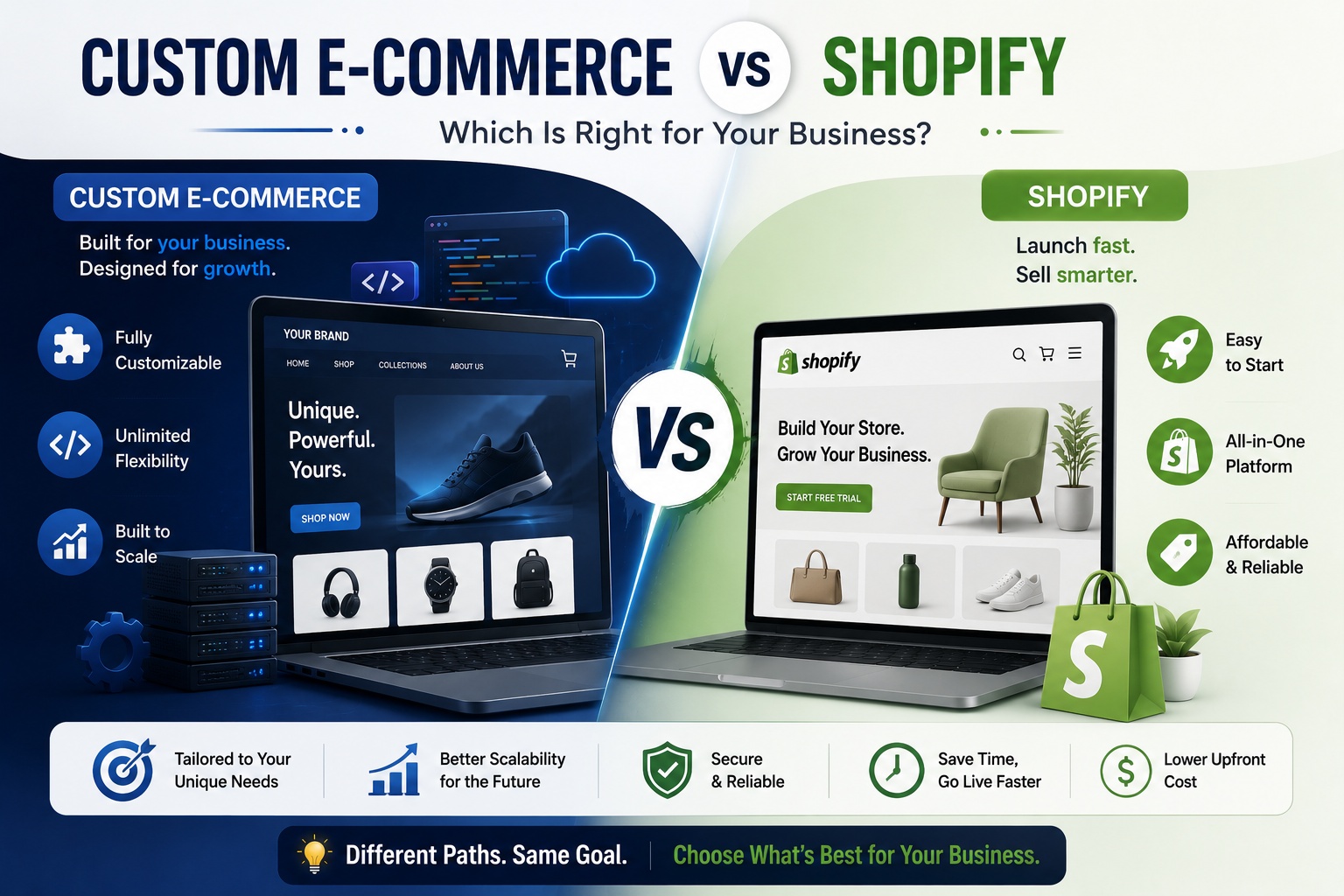
Custom E-Commerce Development vs Shopify: Which Is Right for Your Business?
Introduction
Launching an online store has never been easier, but choosing the right platform remains one of the most important decisions for any business. Shopify has emerged as one of the most popular e-commerce platforms due to its simplicity and ease of use. However, businesses with unique requirements, advanced integrations, and long-term scalability goals often consider custom e-commerce development. Both options offer distinct advantages and challenges. Organizations investing in web development and digital transformation services need to understand which approach aligns best with their business goals. In this article, we compare custom e-commerce development and Shopify across features, flexibility, cost, scalability, and performance to help businesses make an informed decision.
What Is Shopify?
Shopify is a hosted e-commerce platform that enables businesses to quickly create online stores without extensive technical knowledge. It provides built-in tools for product management, payments, themes, analytics, and app integrations. Shopify is ideal for startups and small businesses seeking a faster time-to-market.
What Is Custom E-Commerce Development?
Custom e-commerce development involves building an online store from scratch using frameworks and technologies tailored to a business's specific requirements. Unlike pre-built platforms, custom solutions provide complete control over functionality, user experience, integrations, and scalability.
Ease of Setup and Time to Market
Shopify offers a faster and simpler setup process. Businesses can launch stores within days using templates and apps. Custom e-commerce development requires planning, design, development, and testing, which typically results in longer implementation timelines.
Flexibility and Customization
Custom-built platforms provide unlimited flexibility, allowing businesses to create unique customer experiences and integrate with ERP systems, CRMs, payment gateways, and third-party services. Companies utilizing bespoke solutions often choose custom development to meet specialized business requirements. Shopify, while flexible through apps, has limitations compared to fully customized solutions.
Cost Comparison: Shopify vs Custom Development
Shopify has lower upfront costs and predictable subscription pricing, making it attractive for startups. Custom development requires higher initial investment but may provide better long-term value for businesses with complex workflows and scalability requirements. Hidden costs associated with Shopify apps and transaction fees should also be considered.
Performance and Scalability
As businesses grow, scalability becomes increasingly important. Custom e-commerce platforms allow organizations to optimize infrastructure and performance according to their specific needs. Businesses implementing cloud infrastructure best practices can achieve greater control and scalability compared to standard hosted platforms.
Security and Compliance
Shopify manages security, PCI compliance, and hosting, reducing operational complexity. Custom solutions require businesses to implement and maintain security measures independently but offer greater control over data privacy, compliance, and access management.
SEO and Marketing Capabilities
Both Shopify and custom websites support SEO optimization. However, custom development offers complete control over page structures, performance optimization, schema markup, and advanced SEO strategies. Businesses investing in AI automation and personalization can leverage custom platforms to create highly optimized customer experiences.
Who Should Choose Shopify?
Shopify is ideal for startups, small businesses, entrepreneurs, and brands looking for rapid deployment with minimal technical complexity. It provides a reliable platform for businesses with standard e-commerce requirements.
Who Should Choose Custom E-Commerce Development?
Custom development is best suited for enterprises, marketplaces, B2B platforms, subscription-based businesses, and organizations requiring advanced integrations, unique workflows, and complete control over their online ecosystem.
Conclusion
There is no universal answer when choosing between Shopify and custom e-commerce development. Shopify offers simplicity, speed, and affordability, making it ideal for many businesses. On the other hand, custom e-commerce development provides unmatched flexibility, scalability, and control for organizations with complex requirements and long-term growth ambitions. The right choice ultimately depends on your business model, budget, and future expansion plans.