
Is AI Actually Saving Businesses Money? Comparing Token Consumption to Employee Costs
Introduction
Artificial intelligence is often promoted as a game-changing technology capable of reducing operational costs, increasing productivity, and transforming business processes. Companies across industries are adopting AI-powered tools, AI agents, and automation platforms with the expectation of achieving significant cost savings. However, an important question remains: Is AI actually saving businesses money? While AI systems consume tokens, cloud resources, and infrastructure, human employees require salaries, benefits, training, and ongoing management. To understand the true return on investment (ROI) of AI, businesses must compare AI operating costs against traditional workforce expenses. Organizations working with AI software development companies are increasingly evaluating whether AI can deliver measurable financial benefits. This article explores the economics of AI by comparing token consumption costs with employee-related expenses and examining where AI delivers the greatest value.
What Is AI Token Consumption?
Most modern AI models charge based on token usage. Tokens are units of text processed by AI systems during input and output generation. Every prompt, response, document analysis, or AI-generated report consumes tokens. As AI adoption grows, token consumption becomes a significant factor in calculating operational costs.
How AI Costs Are Calculated
AI expenses typically include token consumption, cloud infrastructure, storage, API usage, monitoring, and maintenance. While the cost of individual AI interactions may appear small, large-scale deployments processing millions of requests per month can generate substantial operational expenses.
The True Cost of Human Employees
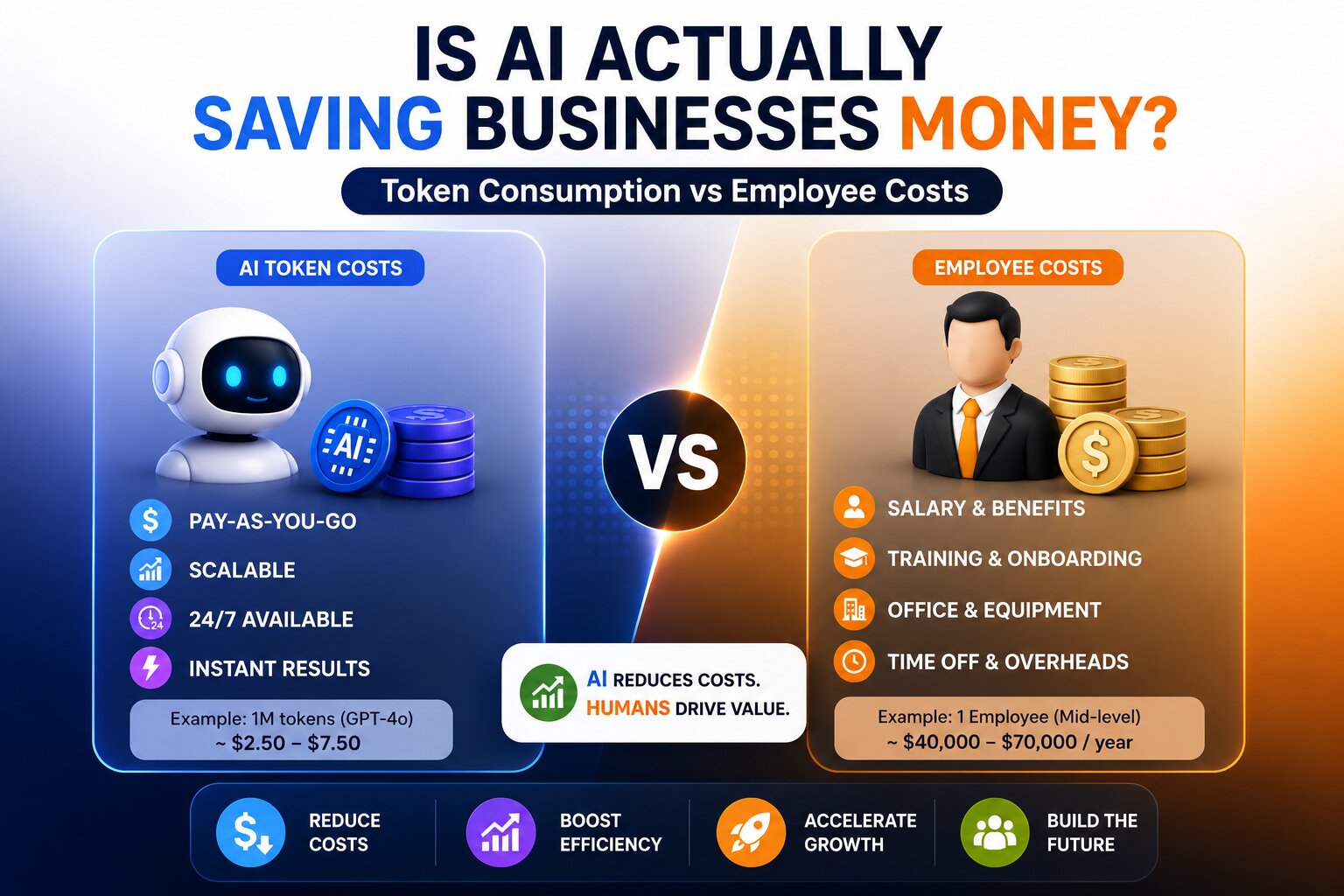
Employee costs extend far beyond salaries. Businesses must also account for benefits, insurance, office space, equipment, training, recruitment, management overhead, and productivity gaps. In many cases, the total cost of an employee can be significantly higher than their base salary.
AI Token Costs vs Employee Costs: A Practical Comparison
For repetitive tasks such as customer support, content generation, data processing, and report creation, AI can often perform work at a fraction of the cost of human labor. For example, an AI-powered support assistant may handle thousands of customer inquiries daily while consuming only a small amount of token-based operational costs compared to hiring multiple support agents.
Where AI Delivers the Biggest Cost Savings
AI is particularly effective in automating repetitive, high-volume tasks. Organizations adopting AI automation often reduce operational costs in customer service, document processing, content creation, software testing, scheduling, and workflow management. These savings can compound over time as AI systems operate continuously without traditional labor constraints.
The Productivity Multiplier Effect
One of AI's greatest benefits is not replacing employees but enhancing their productivity. AI can automate routine tasks, allowing employees to focus on strategic, creative, and customer-facing activities. Companies investing in digital transformation services often use AI as a productivity multiplier rather than a workforce replacement.
Tasks Where Humans Still Outperform AI
Human employees remain essential for roles requiring emotional intelligence, complex decision-making, relationship management, leadership, creativity, and ethical judgment. While AI excels at processing information, it cannot fully replicate human expertise and contextual understanding.
How Businesses Should Measure AI ROI
Successful AI adoption requires measuring outcomes such as time savings, operational efficiency, customer satisfaction, revenue growth, and cost reduction. Businesses should evaluate AI investments based on overall business impact rather than focusing solely on token consumption costs.
The Future Economics of AI
As AI models become more efficient and competition among providers increases, AI costs are expected to decline over time. Businesses leveraging cloud infrastructure best practices and optimized AI architectures will likely achieve even greater returns on investment in the coming years.
Conclusion
AI can absolutely save businesses money, but the answer is more nuanced than simply comparing token costs to employee salaries. The greatest value of AI lies in its ability to automate repetitive work, improve productivity, and enable employees to focus on higher-value activities. Businesses that approach AI strategically, measure ROI effectively, and balance automation with human expertise will be best positioned to maximize cost savings and long-term growth.