
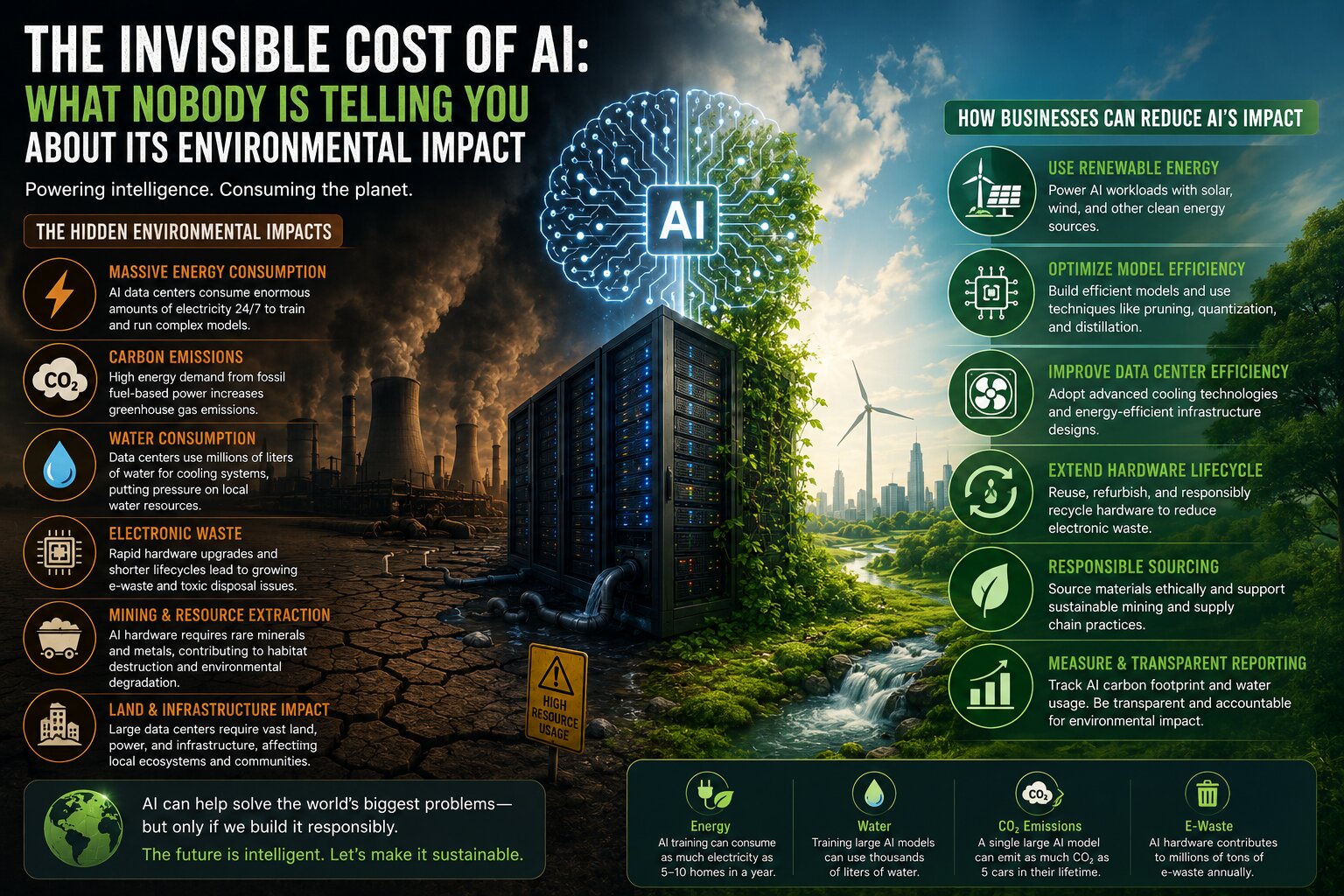
The Invisible Cost of AI: What Nobody Is Telling You About Its Environmental Impact
Introduction
Artificial intelligence is transforming industries, improving productivity, and accelerating innovation. From generative AI and autonomous agents to advanced analytics, AI has become a key driver of digital transformation. However, behind every AI-generated answer lies an enormous physical infrastructure consuming electricity, water, and raw materials. While the world celebrates AI's capabilities, very few people discuss its environmental footprint. Massive AI data centers, high-performance GPUs, and global networking systems require unprecedented amounts of energy to operate. Businesses adopting AI software development companies and intelligent automation must also understand the sustainability challenges associated with AI. This article explores the hidden environmental cost of artificial intelligence and how organizations can adopt more sustainable AI practices.
Why AI Requires Massive Physical Infrastructure
AI may appear digital, but it runs on enormous physical systems. Large language models require thousands of GPUs, high-performance servers, networking equipment, and storage clusters located inside hyperscale data centers. Training a single advanced AI model can involve processing trillions of parameters across thousands of machines running continuously for weeks or months.
The Growing Energy Consumption of AI
Modern AI systems consume enormous amounts of electricity. AI model training and inference require constant computational power, and every user interaction adds to the overall demand. As AI adoption grows globally, data centers are becoming some of the largest electricity consumers. This increased demand often places additional pressure on power grids and can contribute to higher carbon emissions if the energy source is not renewable.
AI's Carbon Footprint and Greenhouse Gas Emissions
The electricity required to power AI infrastructure often comes from fossil fuel-based energy sources. As a result, AI operations indirectly generate carbon emissions. Large AI training runs can produce substantial carbon footprints, especially when powered by non-renewable energy. The rapid expansion of AI data centers has raised concerns among environmental researchers about the long-term climate impact of artificial intelligence.
The Hidden Water Cost of AI Data Centers
One of the least discussed environmental impacts of AI is water consumption. High-performance servers generate significant heat and require cooling systems to maintain safe operating temperatures. Many data centers use water-based cooling technologies that consume millions of liters of water annually. As AI infrastructure expands, water usage may become a major sustainability challenge, particularly in regions already experiencing water scarcity.
Electronic Waste and Hardware Lifecycles
AI systems depend on specialized hardware such as GPUs, processors, memory modules, and networking devices. As technology evolves rapidly, older hardware is frequently replaced to meet increasing computational demands. This contributes to electronic waste, creating additional environmental challenges related to disposal, recycling, and resource extraction.
The Environmental Impact of Mining Critical Materials
Manufacturing AI hardware requires rare earth elements, lithium, cobalt, and other valuable minerals. Mining these materials can have significant environmental consequences, including habitat destruction, water pollution, and increased carbon emissions. The demand for AI hardware is accelerating the global competition for these finite resources.
How AI Data Centers Affect Land and Local Communities
The construction of large-scale AI data centers requires extensive land, infrastructure, and utility resources. In some regions, communities are expressing concerns about increased energy demand, water consumption, and environmental stress associated with hyperscale computing facilities.
Can AI Also Help Protect the Environment?
Despite its environmental costs, AI can also contribute to sustainability. AI is being used to optimize renewable energy grids, improve logistics, reduce fuel consumption, monitor deforestation, predict climate patterns, and increase industrial efficiency. Organizations leveraging AI automation can use AI not only for productivity but also for environmental responsibility.
How Businesses Can Build Sustainable AI Systems
Companies can reduce AI's environmental impact by optimizing models, improving computational efficiency, selecting renewable-powered cloud providers, and adopting cloud infrastructure best practices. Businesses should also monitor AI resource consumption, extend hardware lifecycles, and invest in responsible AI governance.
The Future of Green AI
The future of artificial intelligence must balance innovation with sustainability. Researchers and technology companies are investing in energy-efficient hardware, optimized AI architectures, and environmentally responsible data centers. Organizations embracing digital transformation services should consider sustainability as a core component of their AI strategy.
Conclusion
Artificial intelligence is reshaping the future, but its environmental impact cannot be ignored. Behind every AI interaction lies a complex network of data centers, servers, cooling systems, and global infrastructure consuming valuable natural resources. The challenge for the future is not whether we should adopt AI, but how we can build AI systems that are both powerful and sustainable. Businesses, governments, and technology providers must work together to reduce AI's carbon footprint while continuing to unlock its transformative potential.