
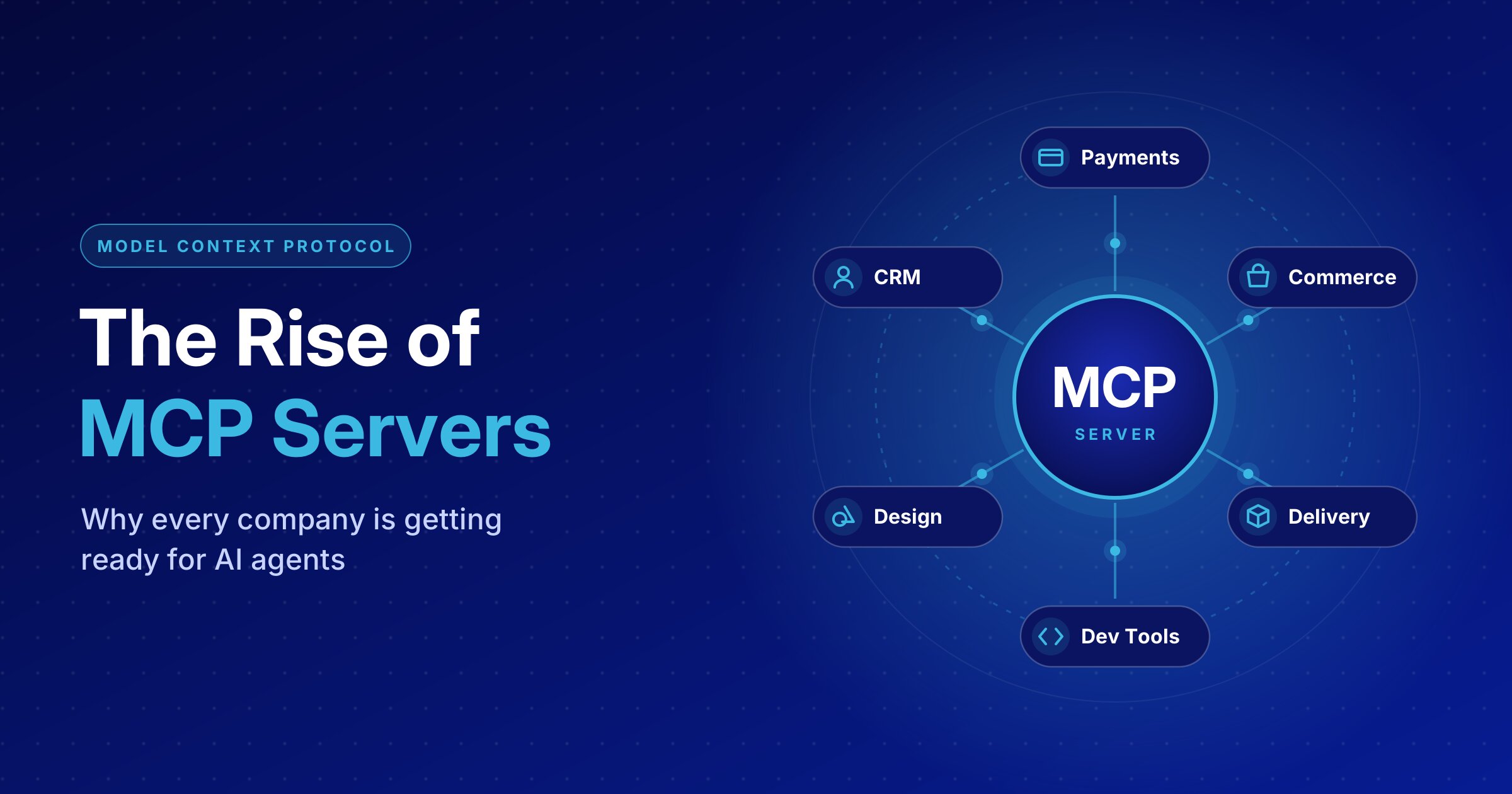
The Rise of MCP Servers: Why Every Company Is Getting Ready for AI Agents
Introduction
For the last twenty years, every serious business needed a website. Then it needed a mobile app. Today a new requirement is quietly taking shape: an MCP server. MCP, the Model Context Protocol, is the open standard that lets AI assistants such as ChatGPT, Claude and Gemini connect to real software and take real actions. Payment providers, developer platforms, design tools, ecommerce platforms and even food delivery companies are now exposing their services through MCP so that AI agents can search, book, buy and manage things on a user's behalf. This article explains what MCP is, why companies across industries are turning their products into MCP servers, how important MCP is likely to become in the AI world, and what small businesses can do to prepare.
What Is MCP (Model Context Protocol)?
MCP is an open standard that defines how AI applications connect to external tools, data and services. Think of it as USB-C for AI: instead of building a custom connector for every AI assistant, a company builds one MCP server, and every MCP-compatible assistant can use it. Anthropic introduced MCP in November 2024. In December 2025 it was donated to the Linux Foundation's newly formed Agentic AI Foundation, co-founded by Anthropic, OpenAI and Block with support from Google, Microsoft, AWS, Cloudflare and Bloomberg. That move turned MCP from one company's project into neutral, industry-owned infrastructure for AI agents.
How an MCP Server Works
An MCP server exposes a list of tools, each with a clear name, a description and structured inputs. A payments company might expose tools such as create_invoice, list_transactions and issue_refund. A food delivery company might expose search_restaurants, update_cart and place_order. When a user asks an AI assistant to do something, the assistant reads the available tools, decides which ones to call, and chains them together to complete the task. The user states the goal once, and the agent handles the steps, usually after the user signs in once through a standard OAuth flow.
The Problem MCP Solves
Before MCP, connecting AI models to business systems was messy. Every AI assistant had its own plugin format, and every company had to build and maintain a separate integration for each one. With many AI assistants and thousands of business tools, the number of custom integrations exploded. MCP replaces that tangle with one shared protocol. Companies build an MCP server once, AI platforms build MCP support once, and everything can work together. It is the same kind of shift that HTTP brought to the web and REST APIs brought to software integration.
MCP vs a Regular API
A REST API is designed for developers, who read documentation and write code to integrate with it. An MCP server is designed for AI agents, which discover the available tools at runtime by reading their descriptions and decide on their own how to use them. MCP does not replace APIs. Most MCP servers sit on top of a company's existing APIs and translate them into a form AI agents understand. The same backend can therefore serve a company's website, its mobile app and AI assistants at the same time.
How Fast MCP Adoption Is Growing
MCP has grown faster than almost any integration standard before it. By December 2025, Anthropic reported more than 10,000 active public MCP servers and over 97 million monthly downloads of the official Python and TypeScript SDKs. By May 2026, the official MCP Registry listed close to 10,000 servers, and GitHub had more than 15,000 repositories tagged as MCP servers. Enterprise adoption is following: in Stacklok's State of MCP in Software 2026 survey, 41% of senior technical leaders said their organisations were already using MCP in production, either in limited or broad deployments. Gartner has predicted that 40% of enterprise applications will feature task-specific AI agents by 2026, and MCP is fast becoming the standard way those agents connect to business systems.
Every Major AI Platform Now Speaks MCP
MCP adoption is not limited to one vendor. Claude was the first MCP client, and support has since spread across the industry. ChatGPT supports connectors and remote MCP servers, Google supports MCP in the Gemini SDK and its Vertex AI Agent Development Kit, Microsoft Copilot Studio can connect agents to MCP servers, and developer tools such as Visual Studio Code and Cursor support MCP natively. For businesses, this means a single MCP server can reach customers and teams across almost every major AI assistant in use today.
Companies Across Industries Are Turning Into MCP Servers
Some of the world's best-known software companies now offer official MCP servers. In developer tools, GitHub launched an official MCP server so AI agents can work with repositories, issues and pull requests, while platforms such as Vercel and Atlassian let agents manage deployments, Jira issues and Confluence pages. In payments and commerce, Stripe and PayPal offer MCP servers for invoices, subscriptions, refunds and transactions, and Shopify provides MCP access to storefronts, products, inventory and orders. In design and content, tools like Canva let AI assistants create and edit designs. Productivity suites, CRM platforms, analytics tools and marketing platforms are following the same path. The pattern is clear: if a product has valuable actions, companies are making those actions available to AI agents.
MCP Reaches Everyday Consumer Services
MCP is not only for developers and enterprise software. In India, leading food delivery and quick-commerce companies have launched MCP servers that let customers search restaurants, browse menus, build carts, apply offers, place orders and track deliveries directly from ChatGPT, Claude or Gemini. One company has opened tens of thousands of grocery products to natural-language ordering through MCP, and has invited outside developers and startups to build new AI experiences on top of its MCP servers. A customer can now say "order my usual biryani from the same place as last time" to an AI assistant, and the order goes through. These companies still run their apps as the main experience, and MCP gives them an additional channel wherever customers ask.
Why Companies Are Racing to Build MCP Servers
The first reason is discovery. More people now start their research, shopping and planning inside AI assistants, and a company that can answer and act inside those assistants is in a strong position to win the customer. The second reason is distribution at low cost: one MCP server reaches every AI assistant that supports the protocol. The third reason is personalisation. Requests such as "plan my meals for the week around my diet" or "reorder whatever I bought last month" are natural as conversations and hard to cover with fixed app features alone. The fourth reason is reuse. Companies are building core capabilities once and letting humans, internal services and AI agents all call them. Finally, MCP is an open, neutrally governed standard, which gives businesses confidence that the investment will last.
MCP Adds a New Channel Alongside Websites and Apps
MCP does not replace websites or mobile apps. It adds a new channel next to them. Browsing for inspiration, comparing visual products and building trust with first-time customers are areas where websites and apps shine. Quick reorders, specific requests and multi-step tasks suit AI assistants. Ordering through an app often means opening it, searching, filtering, comparing, customising, adding to cart and paying. Through an AI assistant, the customer makes one request and the agent calls the right tools. The business backend stays the same, and customers choose the experience that suits the moment.
The Future of MCP in the AI World
Several trends suggest MCP will become even more important over the next few years. AI agents will increasingly act as customers, researching products, comparing options and completing purchases on behalf of people, so businesses will need to be usable by agents and not only by humans. Just as companies once optimised for search engines, they will start optimising for AI agents, with clear tool names, accurate descriptions and reliable data deciding whether an agent chooses them. MCP registries and connector directories are likely to become the app stores of the agent era, where businesses are discovered by AI platforms. MCP will also work alongside newer standards for agent-to-agent communication and agent-driven payments, forming a full stack for agentic commerce. And as adoption grows, the protocol's security, identity and permission features will mature, making it suitable for more sensitive industries such as banking, healthcare and government services. The likely end state is simple: having an MCP server will feel as normal as having a website.
From User Experience to Agent Experience
Product teams now design for two audiences: people using screens and AI agents using tools. For agents, good design means clean, well-described actions such as search, quote, book and pay. Tool descriptions become a new kind of UX copy, because an AI agent picks a tool based on its name and description, and vague descriptions mean the agent may skip you. Response speed, accurate data and predictable errors matter just as much. Companies that invest in this agent experience early will have an advantage as AI-driven traffic grows.
What MCP Means for Small Businesses
Large companies have engineering teams to build and run multiple MCP servers. A salon in Kochi, a clinic in Bengaluru or a D2C jewellery brand does not. But the same shift is coming for them. Customers will increasingly ask AI assistants to book appointments, find products, check prices or place orders, and businesses that AI agents can reach will be part of those conversations. Small businesses should ask three questions. Can an AI agent answer questions about your products, prices and policies, or does that knowledge live only in PDFs, WhatsApp chats and staff memory? Can an agent take an action, such as booking a slot, capturing a lead or checking an order status? And is there a human fallback when the agent cannot help?
Practical First Steps to Become Agent-Ready
Start by putting your FAQs, product catalogue and policies into one structured knowledge base. Next, define the three to five actions customers ask for most, such as book, enquire, track and reorder. Expose those actions through a conversational AI layer on your own channels first, such as website chat and WhatsApp, and then through MCP so external AI assistants can reach them. Add a clear human handoff for complex cases. Finally, measure what customers and agents ask for that you cannot yet do. That list becomes your roadmap.
How B6AI Uses MCP to Make Businesses Agent-Ready
B6AI, built by BytesNBinary, is an AI conversational automation platform for small and growing businesses, and MCP is built into it in two directions. First, B6AI ships its own MCP server, so a business owner can build and manage an entire AI agent from Claude or ChatGPT. Through it, an assistant can generate a bot from a single prompt, add knowledge by crawling a website, importing documents or adding FAQs, design conversation flows by adding and connecting nodes, create intents and auto-generate training phrases, test intent detection, and style the chat widget to match the brand. You describe what you want, and the AI calls B6AI's tools.
Connect Any MCP Server to Your B6AI Agent
Second, inside a B6AI conversation flow, an external MCP server can act as a tool. Your B6AI agent can call a booking system, CRM, payment platform or inventory service in the middle of a customer conversation, using the same open standard that powers the largest AI platforms. B6AI is also extending this so that a business's own flows can be exposed as MCP endpoints on the Enterprise plan, letting outside AI assistants book, enquire or check status with that business directly, without the business building MCP infrastructure itself.
What Sits Underneath B6AI's MCP Layer
MCP is only as useful as what it connects to. B6AI pairs it with a RAG-powered knowledge base, a visual flow builder, multi-channel delivery across website chat, WhatsApp, Instagram, Telegram and Messenger, and a full human handoff system with routing rules and a live agent inbox. When an AI agent cannot resolve something, a real person can step in without the customer starting over.
Challenges and Risks to Plan For
MCP adoption has moved faster than its security practices, so anyone shipping an MCP server should plan carefully. Coarse permissions are common in early servers, where access is granted at the server level rather than per tool, so an agent allowed to read data may also be allowed to change it. Put a policy layer in front of sensitive actions. Agents retry requests, so without idempotency keys a retry can create a duplicate order or double-book a slot. Prompt injection is a real threat: text inside a document, review or web page can try to steer the agent, so tool outputs must be treated as data, never instructions. Brand presence is thinner when a conversation happens inside a third-party assistant. Customer data flows through those assistants too, so Indian businesses should plan for DPDP Act obligations from day one. Finally, avoid dependence on a single AI model provider and keep models swappable.
FAQ: What Is an MCP Server?
An MCP server exposes a business's actions and data, such as search, book, order, invoice or track, as tools that AI assistants like Claude, ChatGPT and Gemini can call on a user's behalf, using the open Model Context Protocol.
FAQ: Why Are Companies Building MCP Servers?
Because customers increasingly use AI assistants to research, shop and get work done. An MCP server makes a company's services available inside those assistants, giving it a new channel for discovery and sales without building a separate integration for each AI platform.
FAQ: Is MCP the Future of AI Integration?
MCP is now governed by the Linux Foundation's Agentic AI Foundation and supported by every major AI platform, including Claude, ChatGPT, Gemini and Microsoft Copilot. With thousands of public servers and rapid enterprise adoption, it is widely seen as the emerging standard for connecting AI agents to business systems.
FAQ: What Is the Difference Between MCP and an API?
An API is designed for developers to integrate with code. An MCP server describes its tools so AI agents can discover and use them at runtime, and a single MCP server works across every MCP-compatible assistant. Most MCP servers are built on top of existing APIs.
FAQ: Will MCP Replace Websites and Mobile Apps?
No. MCP adds a new channel for quick, intent-clear tasks through AI assistants, while websites and apps remain important for browsing, visual comparison and building trust. Businesses benefit most when they offer both.
FAQ: Do Small Businesses Need an MCP Server?
Not on day one, but they do need to be agent-ready: structured knowledge, clearly defined actions and a human fallback. Platforms like B6AI provide this without custom engineering and can connect businesses to the MCP ecosystem.
FAQ: Is MCP Secure?
The protocol supports OAuth-based sign-in, but security depends on the implementation. Use per-tool permissions, make actions idempotent, log agent activity, and treat all tool output as untrusted data.
Conclusion
MCP has gone from a new open-source protocol to a shared industry standard in less than two years. Payment providers, developer platforms, ecommerce platforms, design tools and consumer services are all turning their products into MCP servers, because customers and teams increasingly expect to get things done through AI assistants. In the coming years, being reachable by AI agents is likely to matter as much as being reachable through search engines and app stores. The good news for smaller businesses is that they do not need a large engineering team to take part. Structure your knowledge, define your core actions, keep a human in the loop, and make those actions available to AI agents. The businesses that prepare for the agent era today will be the ones AI assistants can find and trust tomorrow.