
We're Shipping Software Nobody Understands. Here's Why That's Dangerous.
Introduction
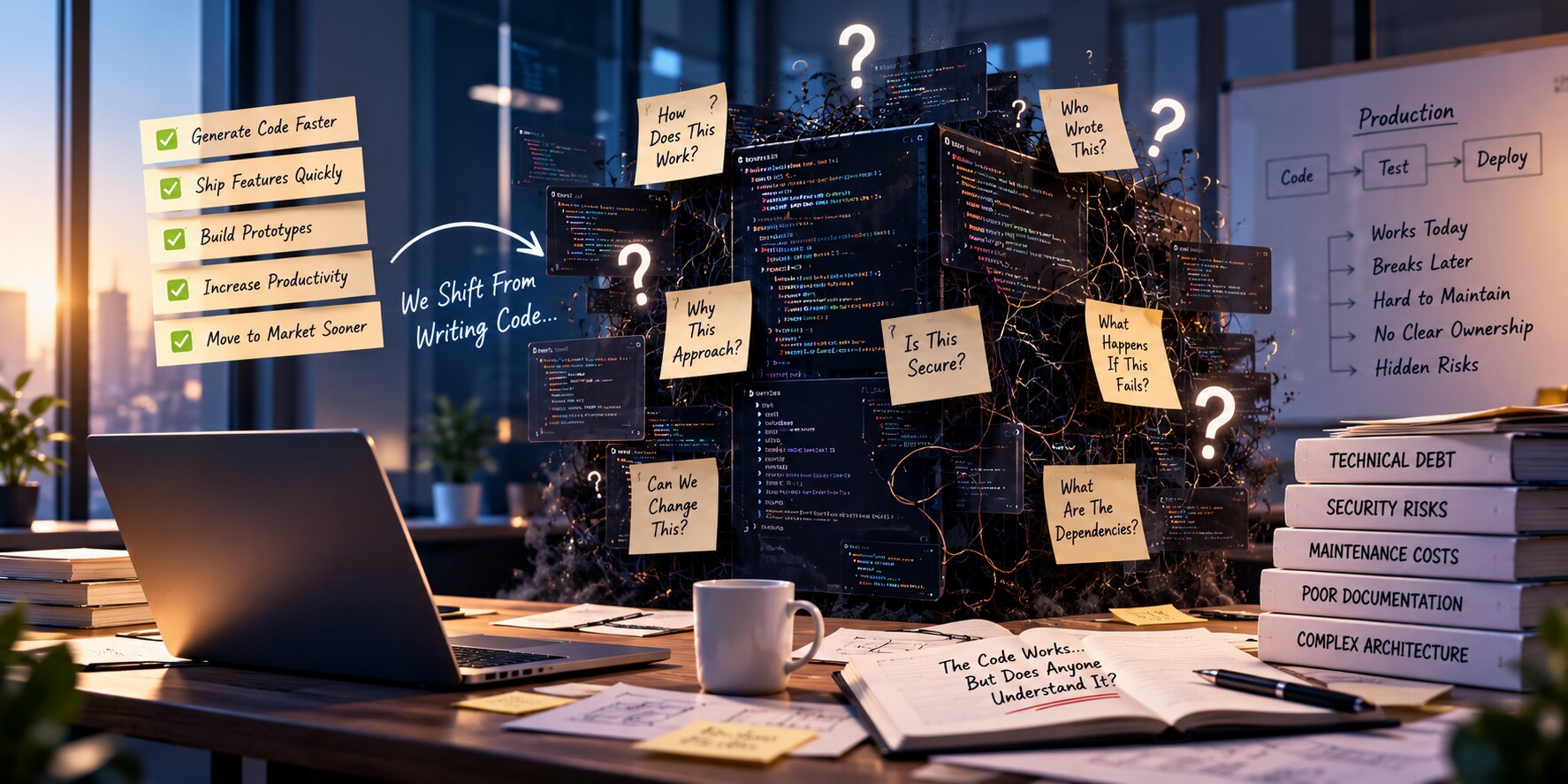
We have entered an era where writing software is becoming easier than ever. AI coding assistants can generate functions, build components, write tests, suggest fixes, and help developers create entire applications from natural-language instructions. Teams can build prototypes faster, deliver features sooner, and experiment with ideas that previously required significant engineering effort. But there is a question hiding behind all this productivity: if we can generate software faster than we can understand it, what happens when that software breaks? A feature may work in development, pass basic tests, and reach production successfully. Months later, a production issue appears, and nobody fully understands why the code behaves that way. The documentation is incomplete, the original developer has moved on, and even a small change feels risky. This is the growing challenge of modern software engineering. As AI-assisted development becomes more common, teams must focus not only on how quickly they produce code, but also on whether they can explain, test, secure, maintain, and safely change what they ship. Because shipping software and understanding software are two very different achievements.
1. The New Definition of Developer Productivity
For years, software development productivity was closely associated with implementation effort. Developers wrote code, reviewed pull requests, fixed bugs, and delivered features. AI coding tools are changing that equation by generating implementations, suggesting modifications, and automating repetitive development tasks. However, reducing the time spent writing code does not automatically reduce the time required to build reliable software. Consider a subscription management feature for a SaaS application. An AI assistant might generate the user interface, API endpoints, database models, and billing logic. But does the implementation correctly handle failed payments, duplicate webhooks, expired subscriptions, authorization, and retries? Does it fit the existing architecture? Does it preserve data integrity? These questions require engineering judgment. Developer productivity should be measured by reliable outcomes, maintainability, and business value—not simply by how much code is produced.
2. AI Makes It Easier to Create Code Than to Understand It
Teams adopting AI Software Development & Integration can use AI coding assistants to produce plausible implementations quickly, but generated code may introduce abstractions, dependencies, or design decisions that developers do not fully understand. The implementation can arrive before the developer has developed a clear mental model of how it works. For example, an AI-generated authentication flow might handle ordinary logins correctly but fail when a session expires, a tenant identifier is missing, or a user attempts to access another organization's data. The code may be syntactically correct and still contain a serious design flaw. This does not mean AI-generated code is inherently unreliable. Human-written code also contains defects, and AI tools can help identify and resolve them. The concern is that code generation can outpace a team's ability to evaluate the result. Teams should use AI to accelerate implementation while making understanding, testing, and validation essential parts of the development process.
3. Working Software Is Not the Same as Understandable Software
A feature can work today and still be difficult to maintain tomorrow. Imagine an application where developers and AI tools have contributed code over several months. Each feature works independently, but the overall architecture has become difficult to explain. One module handles a business rule, another duplicates it, and a third applies slightly different validation. API endpoints return inconsistent errors, and database access is scattered across multiple layers. There may be no single catastrophic defect, yet the system becomes increasingly difficult to reason about. Understandable software makes it easier to investigate production incidents, onboard developers, review changes, identify security weaknesses, and implement new requirements safely. A production-ready feature should therefore be more than a successful demonstration. For customer-facing products, a Bespoke UI/UX Design Solution can also support clearer, more consistent user journeys. The team should understand its responsibilities, dependencies, data flow, failure modes, and expected behavior.
4. AI Is Changing How Technical Debt Accumulates
Technical debt has always been part of software development. Teams make trade-offs between delivery speed, implementation cost, and long-term maintainability. AI-assisted development can make it easier to accumulate complexity because workarounds, duplicate implementations, and new abstractions can be generated quickly. One developer may introduce a workaround for a business rule, another may generate a separate solution for the same problem, and a third may add another abstraction to make a feature work. Each decision may appear reasonable in isolation, but together they can create duplicated logic, unnecessary dependencies, inconsistent conventions, and undocumented assumptions. The problem is not simply that AI generates more code. It is that teams may accept more implementation decisions without considering their long-term consequences. Digital Transformation Services can help organizations modernize processes and systems. Technical debt should be managed deliberately through architecture reviews, refactoring, automated checks, and clear ownership rather than allowed to accumulate unnoticed.
5. Why Code Review Is Becoming More Important
AI Software Development & Integration does not make code review less important; it makes thoughtful review and validation even more valuable. In many situations, it makes thoughtful review more valuable. Generated code may look polished while containing assumptions that were never discussed. Reviewers need to determine whether the implementation satisfies the business requirement, follows the architecture, protects data, handles failures, and introduces unnecessary complexity. They should also examine whether tests meaningfully validate the expected behavior or simply confirm the implementation's assumptions. AI tools can assist with reviewing code, but their recommendations also require verification. The purpose of code review is not merely to check formatting or identify obvious syntax errors. It is to evaluate whether the implementation belongs in the system and whether the team can safely operate and maintain it. The value of a reviewer lies in recognizing what the code might get wrong.
6. The Most Dangerous Code Is Sometimes the Code That Almost Works
Some difficult software failures emerge when an implementation works under ordinary conditions but fails under unusual circumstances. An AI-generated payment workflow may handle successful transactions but mishandle duplicate webhook events. A permission check may work for administrators but fail to isolate data between tenants. A background job may process one request correctly but duplicate work when retries occur. These problems are difficult because the implementation appears reasonable: the code compiles, the interface looks correct, and the main scenario passes. This is why engineering teams must test more than the happy path. Testing should cover failure conditions, boundary values, concurrent operations, authorization, retries, data integrity, and interactions with existing components. AI can help generate tests, but generated tests should not automatically be treated as proof of correctness. Tests need to challenge assumptions independently and verify the behavior the system is expected to guarantee.
7. Security Becomes Harder When Understanding Falls Behind
Security risks deserve particular attention when software is generated quickly. A system can appear functional while exposing sensitive information, trusting unvalidated input, assigning excessive permissions, or mishandling authentication. In multi-tenant SaaS applications, authorization must ensure that one organization cannot access another organization's records. An API might verify that a user is logged in without correctly verifying that the requested resource belongs to that user's tenant. That difference can have serious consequences. AI-generated integrations may also mishandle secrets, trust external responses, or introduce dependencies that require additional scrutiny. Cloud Services & Infrastructure can support secure, reliable infrastructure practices. Businesses should use established security practices, automated scanning, appropriate access controls, dependency checks, threat modeling, and human review for sensitive changes. AI can help implement security controls, but teams must verify that those controls work in the actual system.
8. Documentation Must Explain Decisions, Not Just Functions
Documentation is often postponed when delivery deadlines become tight. AI-generated code can make this problem worse when teams assume that readable code or automatically generated comments are sufficient. However, explaining what a function does is not the same as explaining why the system was designed that way. In Web Development Services projects, useful engineering documentation should capture important architectural decisions, service responsibilities, data flows, integration assumptions, failure scenarios, security boundaries, and operational procedures. This information helps future developers distinguish intentional design decisions from accidental behavior. Documentation does not need to describe every line of code. It should preserve the knowledge that would otherwise disappear when the original developer leaves or the implementation changes. Good documentation reduces uncertainty and makes software easier to maintain over time.
9. The Senior Engineer's Role Is Changing
As AI tools take on more implementation work, experienced engineers may spend more time defining architecture, evaluating generated solutions, reviewing system boundaries, debugging failures, and making technical trade-offs. This does not make senior engineering less valuable. It changes where some of that value is created. Experienced engineers contribute by understanding business problems, identifying hidden risks, choosing appropriate abstractions, and anticipating how changes affect the wider system. AI can generate several possible implementations, and AI Software Development & Integration can accelerate delivery when engineers remain responsible for evaluating the results. but an engineer must still determine which implementation belongs in the product. That requires understanding the existing architecture, business constraints, security requirements, and acceptable trade-offs. Teams should treat AI as a tool for extending engineering capability, not as a substitute for architectural ownership.
10. Junior Developers Still Need to Learn How Systems Work
When developers rely on AI to generate implementations before learning the underlying concepts, they may miss opportunities to develop the intuition required for debugging and system design. This outcome is not inevitable. AI can be an effective learning tool when developers use it to explain unfamiliar code, compare approaches, generate exercises, and challenge assumptions. A developer who copies an AI-generated authentication system may learn less than one who asks why a particular session strategy was chosen, which threats it addresses, and how it could fail. Developers should learn to trace requests through an application, understand databases and transactions, evaluate API contracts, diagnose production issues, write meaningful tests, and explain architectural trade-offs. The goal is not to compete with AI at typing code. It is to develop the understanding needed to direct, evaluate, and maintain the systems AI helps create.
11. How Engineering Teams Can Ship Faster Without Losing Understanding
The solution is not to abandon AI-assisted development. With AI Software Development & Integration, teams should build engineering practices that scale with the speed of implementation. It is to build engineering practices that scale with the speed of implementation. First, establish clear architectural boundaries so that modules have defined responsibilities and business rules are not duplicated unnecessarily. Second, apply stronger review to high-risk changes involving authentication, authorization, payments, sensitive data, infrastructure, and database migrations. Third, create tests from business requirements and expected behavior rather than relying exclusively on tests generated alongside the implementation. Fourth, introduce automated quality gates such as linting, type checking, unit tests, security scanning, dependency analysis, and build validation. Fifth, document important architectural decisions, API contracts, and operational procedures. Finally, monitor production through structured logs, error tracking, alerts, and rollback mechanisms. Delivery plans must include time for investigation, review, testing, and maintenance. Use AI to accelerate implementation and engineering discipline to control the consequences.
12. Measure Engineering Outcomes Beyond Lines of Code
More commits, more pull requests, and more lines of code do not necessarily indicate better engineering. AI changes how code is produced, making traditional output measures less informative when used alone. Teams undertaking Digital Transformation Services should track outcomes as well as implementation activity, including measures that reflect delivery quality and sustainability, including lead time from a committed change to production, change failure rate, time to recover from incidents, escaped defects, production regressions, test effectiveness, and the effort required to maintain or modify existing modules. Developer onboarding time and recurring sources of technical debt can also reveal whether a system is becoming harder to understand. No single metric tells the whole story, and metrics should not encourage teams to optimize one number at the expense of quality. The objective is to understand whether the organization is delivering useful changes reliably, not simply whether it is producing more code.
13. The Real Question Is Not Whether AI Wrote the Code
It is easy to turn this discussion into an argument about human-written code versus AI-generated code, but that misses the point. Developers have always written code they later struggled to understand. Poor architecture, rushed delivery, inadequate testing, and undocumented decisions existed long before AI coding assistants. AI changes the speed and economics of implementation. It can amplify good engineering practices, but it can also amplify weak ones. A well-designed workflow uses AI to reduce repetitive work while keeping requirements, architecture, testing, security, and accountability visible. A poorly designed workflow treats a successful build as evidence that the implementation is ready to trust. The important distinction is not who or what generated the code. It is whether the team can demonstrate that the resulting software meets its requirements, protects its users, behaves reliably, and can be maintained.
14. The Future Belongs to Teams That Understand What They Ship
The ability to generate software quickly is a powerful advantage. It helps businesses experiment, shorten development cycles, and bring products to market sooner. However, speed alone is not a sustainable engineering strategy. When teams ship code they cannot explain, they make future debugging, security reviews, maintenance, and product changes more difficult. The costs may not appear during the initial demonstration or deployment. They often emerge months later, when requirements change and nobody fully understands the system's behavior. AI is not the enemy of good software engineering. Unquestioned automation is the risk. Whether delivered through Mobile App Development or the web, products need maintainable engineering foundations. The next stage of software development should combine AI-assisted implementation with strong architecture, meaningful testing, security reviews, clear documentation, and engineers who understand the systems they maintain. The real measure of progress is not how quickly a team can generate code, but how confidently it can change, operate, and maintain that software after it ships.
Conclusion
AI coding tools are making software development faster, but faster implementation does not automatically produce better software. When teams ship code they cannot explain, test, or maintain, they create risks that may emerge long after deployment. These risks include growing technical debt, difficult debugging, security weaknesses, inconsistent architecture, and costly future changes. The answer is not to reject AI. It is to combine AI-assisted development with engineering judgment, architectural discipline, meaningful testing, security controls, and documentation that preserves important decisions. Software teams must remain accountable for the systems they release, regardless of how the code was generated. At BytesNBinary, we believe scalable software requires more than rapid implementation. It requires thoughtful architecture, reliable engineering practices, and technology choices that support long-term business goals. Build faster, understand deeper, and ship with confidence.