
The Rise of Digital Twins: How Virtual Copies Are Transforming the Real World
Introduction
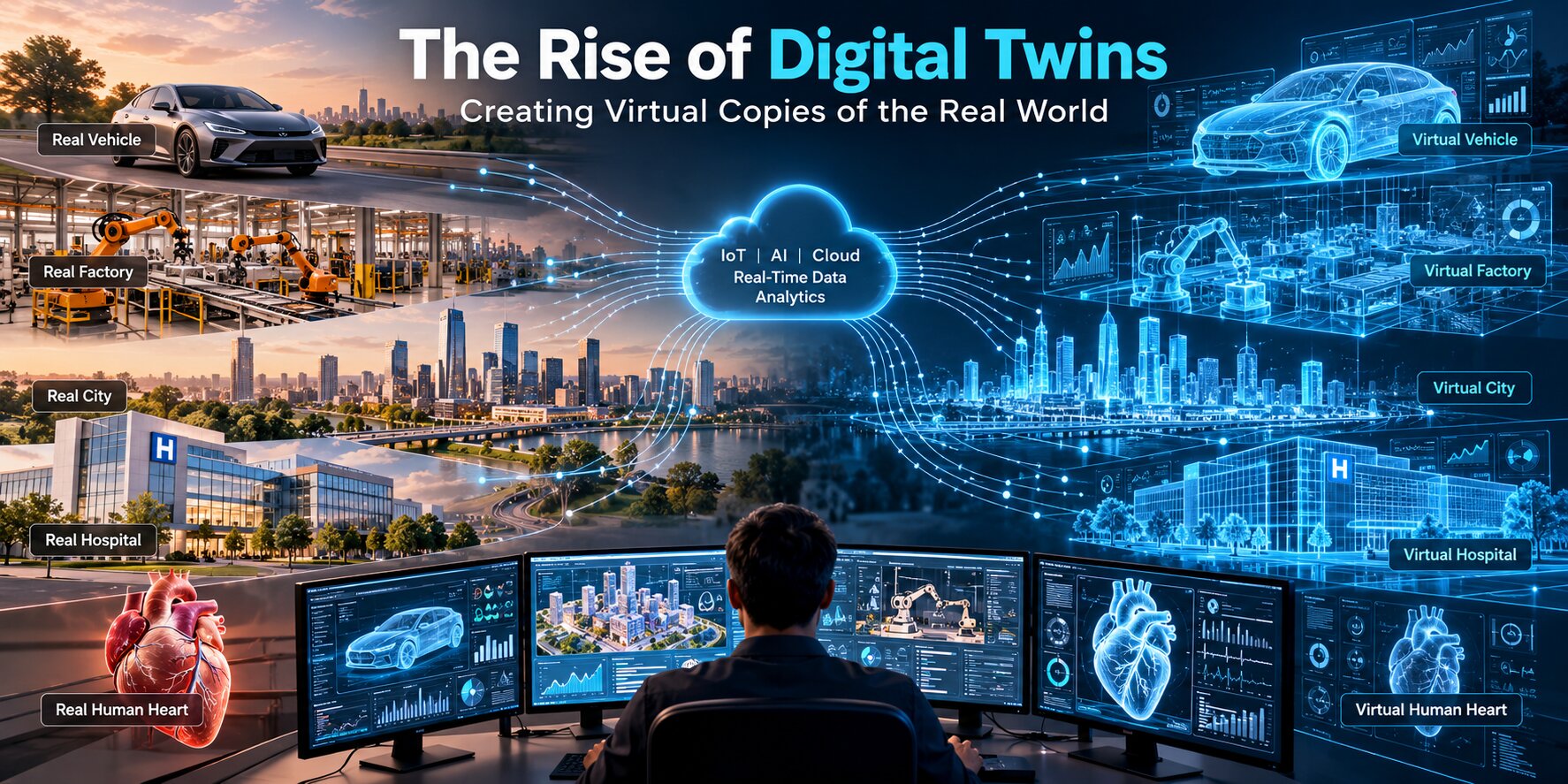
Imagine having a virtual copy of your car that behaves like the real vehicle. You could monitor its performance, identify potential failures, test different driving conditions, and predict maintenance requirements without physically interfering with the vehicle. Now imagine doing the same thing with an entire factory, a hospital, a smart city, or even a human heart. This is the idea behind digital twins. A digital twin is a virtual representation of a physical object, system, process, or environment that can be connected to real-world data. Sensors, IoT devices, software systems, artificial intelligence, cloud computing, and analytics can continuously feed information into the digital model, allowing organizations to understand what is happening in the physical world and simulate what could happen next. Digital twins are moving beyond traditional simulations. Businesses are increasingly exploring them to monitor operations, predict failures, optimize performance, reduce costs, improve product design, and make better decisions. As AI, IoT, cloud computing, and real-time analytics continue to advance, digital twins are becoming an important part of the next generation of digital transformation.
1. What Is a Digital Twin?
A digital twin is a virtual representation of a physical object, system, process, or environment. Unlike a simple 3D model or static simulation, a digital twin can be connected to real-world information and updated as the physical asset changes. Consider a manufacturing machine. Sensors attached to the machine can collect information such as temperature, vibration, pressure, energy consumption, operating speed, production output, and maintenance history. That information can be transferred into a digital representation of the machine. The digital twin can then help engineers understand the current condition of the asset and identify potential problems before they become expensive failures. In simple terms, the concept connects the physical world with the digital world through data. Physical asset, sensors, real-time data, digital representation, analytics, and decisions become part of one connected technology ecosystem.
2. How Does Digital Twin Technology Work?
Digital twin technology typically combines several technologies rather than relying on one technology alone. IoT devices and sensors collect information from physical assets and environments. That information is transmitted to data platforms where it can be stored, processed, and analyzed. Cloud infrastructure provides the scalability required to manage large volumes of data, while artificial intelligence and machine learning can identify patterns and potential problems. Simulation technologies allow organizations to test different scenarios in a virtual environment before making changes to the physical system. Visualization tools, dashboards, 3D environments, and other interfaces help teams understand complex information. The result is a connected technology ecosystem where data from the physical world continuously informs the digital model and the digital model helps people make better decisions about the physical system.
3. Digital Twins vs Traditional Simulations
Digital twins and traditional simulations are related, but they are not exactly the same. A traditional simulation generally models how a system could behave under specific assumptions or conditions. A digital twin goes further by connecting the virtual representation to a real physical system and incorporating real-world information. For example, a traditional simulation might ask what could happen if a machine operates at a higher temperature. A connected digital twin can use the machine's current temperature, vibration, operating history, and other information to help determine what is happening now and what could happen next. This continuous connection makes digital twins particularly useful for monitoring, prediction, optimization, and operational decision-making. Simulation remains an important component of digital twin technology, but the real-world data connection is what gives a digital twin its distinctive value.
4. The Role of IoT in Digital Twins
Digital twins depend heavily on data, and this is where the Internet of Things becomes particularly important. IoT devices can continuously collect information from machines, vehicles, buildings, factories, infrastructure, and other physical environments. Sensors can measure temperature, pressure, movement, vibration, location, energy consumption, and many other operational parameters. In a smart factory, for example, sensors can monitor production equipment, energy usage, inventory movement, production speed, and equipment health. This information can be reflected in a digital twin, giving the organization a more detailed view of what is happening across its physical operations. Without reliable data, a digital twin risks becoming nothing more than a static digital model. IoT provides the continuous flow of real-world information that allows the digital representation to remain useful and relevant.
5. How AI Makes Digital Twins More Powerful
Artificial intelligence can significantly increase the value of digital twins. A basic digital twin can help show what is happening, while an AI-powered digital twin can help identify why something may be happening and what could happen next. Machine learning models can analyze historical and real-time information to detect patterns that may be difficult for humans to identify manually. For example, an AI-powered digital twin could analyze changes in vibration, temperature, energy consumption, or production performance and identify patterns associated with potential equipment problems. AI can also support scenario analysis, optimization, anomaly detection, forecasting, and decision support. This creates an important progression from monitoring to prediction and eventually toward optimization. As AI capabilities continue to advance, digital twins could become increasingly intelligent systems that help organizations understand complex physical environments.
6. Digital Twins in Manufacturing
Manufacturing is one of the most significant application areas for digital twins. Manufacturers can create digital representations of machines, production lines, factories, products, and supply chain processes. Before physically changing a production line, engineers can use the digital environment to evaluate different configurations and potential outcomes. They can examine whether a change could increase production, create bottlenecks, affect energy consumption, or introduce operational risks. Digital twins can also support predictive maintenance by helping teams identify unusual patterns in equipment behavior. Instead of waiting for a machine to fail, manufacturers can investigate potential problems earlier. This can help reduce unplanned downtime, improve asset utilization, and support more informed operational decisions.
7. Digital Twins in Healthcare
Healthcare represents another fascinating area for digital twin applications. Digital twin technology can be used to model medical devices, healthcare facilities, biological systems, and other complex environments. In research and advanced applications, increasingly detailed models may also help researchers explore patient-specific physiological scenarios. For example, a digital model could potentially help researchers evaluate how a medical device might behave under different conditions or study how a complex biological system responds to particular scenarios. However, healthcare applications require particularly strong attention to data privacy, security, accuracy, ethics, and regulatory requirements. The more sensitive the underlying information, the more important responsible architecture, governance, and access controls become.
8. Digital Twins for Smart Cities
A city is an incredibly complex system where transportation, buildings, energy infrastructure, water systems, public services, environmental conditions, and emergency response are interconnected. A city-scale digital twin can bring information from different sources into a virtual representation of the urban environment. City planners could potentially use digital twins to study traffic patterns, transportation changes, infrastructure development, energy demand, construction projects, environmental conditions, and emergency scenarios. Instead of evaluating major changes only after they are implemented physically, planners can use virtual models to explore potential outcomes beforehand. Digital twins can therefore support smarter planning, resource optimization, and data-driven decision-making as cities become increasingly connected.
9. Digital Twins in Automotive and Transportation
The automotive and transportation industries are also strong candidates for digital twin applications. A digital twin can represent a vehicle throughout its lifecycle, from design and manufacturing to operation and maintenance. Manufacturers can use virtual representations to evaluate vehicle performance, test components, identify potential problems, and improve product designs. Similar approaches can be applied to aircraft, trains, ships, logistics networks, charging infrastructure, and transportation systems. For connected vehicles and other assets, real-world operational information can provide additional insights into how systems behave under different conditions. Digital twins can therefore help transportation organizations move toward more predictive maintenance, better asset management, and data-driven operational planning.
10. Digital Twins and Predictive Maintenance
One of the most practical applications of digital twins is predictive maintenance. Traditional maintenance often follows either a reactive or preventive approach. Reactive maintenance means fixing equipment after it fails, while preventive maintenance involves servicing equipment according to a predetermined schedule. Predictive maintenance uses operational data to identify when an asset may require attention. A digital twin can combine sensor information, historical maintenance records, equipment behavior, and analytical models to help identify potential warning signals. For example, unusual changes in vibration, temperature, or energy consumption may indicate that a component requires investigation. By identifying potential issues earlier, organizations can plan maintenance more effectively and reduce the risk of unexpected downtime.
11. Digital Twins and Digital Transformation
Digital transformation is not simply about moving existing processes to the cloud. It involves using technology, data, and modern systems to improve how an organization operates. Digital twins can become an important component of this transformation because they connect physical assets, real-time data, software, AI, and decision-making. Businesses can use digital twins to create greater visibility into operations and support more informed decisions. When combined with cloud platforms, AI solutions, IoT infrastructure, and modern application architectures, digital twins can become part of a broader technology ecosystem. Organizations exploring this type of modernization can benefit from a structured digital transformation strategy that connects technology investments with measurable business outcomes.
12. What Are the Benefits of Digital Twins?
Digital twin technology can provide several potential business and operational benefits. Organizations can gain better visibility into physical assets and complex systems through real-time information. Predictive analytics can help identify potential failures before they become major incidents. Virtual testing can reduce the need for costly physical experimentation during product development and operational planning. Digital twins can also help optimize resource usage, maintenance schedules, production processes, and energy consumption. Product teams can evaluate designs before physical prototypes are created, while operations teams can explore different scenarios without immediately affecting production environments. The overall value comes from connecting data and simulation with real-world decision-making.
13. What Are the Challenges of Digital Twin Technology?
Despite their potential, digital twins are not simple to implement. Data quality is one of the most important challenges because inaccurate or incomplete information can produce misleading results. Integration can also be complex because digital twins may need to connect IoT devices, enterprise applications, databases, cloud platforms, and legacy systems. Cybersecurity is another major concern because connecting physical assets to digital environments creates additional attack surfaces. Building sophisticated digital twin infrastructure can also require significant investment in sensors, software, cloud infrastructure, data engineering, integration, and specialized expertise. Scalability becomes increasingly important when organizations attempt to manage thousands or millions of connected assets. Privacy, governance, access control, and data ownership must also be considered when digital twins process sensitive business or personal information.
14. The Future of Digital Twins
The future of digital twins is closely connected to advances in artificial intelligence, IoT, edge computing, cloud computing, high-speed connectivity, simulation, and real-time analytics. Today's digital twin may primarily help an organization understand what is happening. Future digital twins could become more predictive and intelligent, helping organizations identify problems, recommend actions, simulate future scenarios, optimize complex systems, and continuously learn from new information. The technology could expand from individual machines and products to entire factories, buildings, cities, transportation networks, and interconnected ecosystems. As these systems become more sophisticated, the boundary between physical operations and digital intelligence may become increasingly difficult to separate.
15. Why Digital Twins Could Become a Competitive Advantage
Digital twins are not valuable simply because they create impressive virtual models. Their real value comes from helping organizations understand, predict, and improve real-world operations. Companies that can convert physical-world data into actionable intelligence may gain advantages in operational efficiency, product innovation, maintenance, customer experience, resource optimization, risk management, and sustainability. However, the organizations that benefit most will likely be those that treat digital twins as part of a broader technology strategy rather than as an isolated technology project. The strongest implementations will connect digital twins with reliable data infrastructure, AI, cloud platforms, security controls, software applications, and clear business objectives. The goal should not simply be to create a digital copy. It should be to create a useful digital representation that helps the organization make better decisions.
Conclusion
Digital twins represent a major step toward connecting the physical and digital worlds. What started as sophisticated modeling technology is evolving into an intelligent approach for monitoring, simulating, predicting, and optimizing real-world systems. From factories and vehicles to hospitals and smart cities, digital twins can help organizations understand complex environments without relying entirely on physical experimentation. But the real opportunity lies in combining digital twins with AI, IoT, cloud computing, real-time analytics, and modern software architecture. The future may not simply be about creating digital copies of physical objects. It may be about creating intelligent digital counterparts that can help us understand what is happening, predict what comes next, and make better decisions before changes happen in the real world. As physical environments become increasingly connected, digital twins could become one of the technologies that helps businesses understand, optimize, and transform them.