
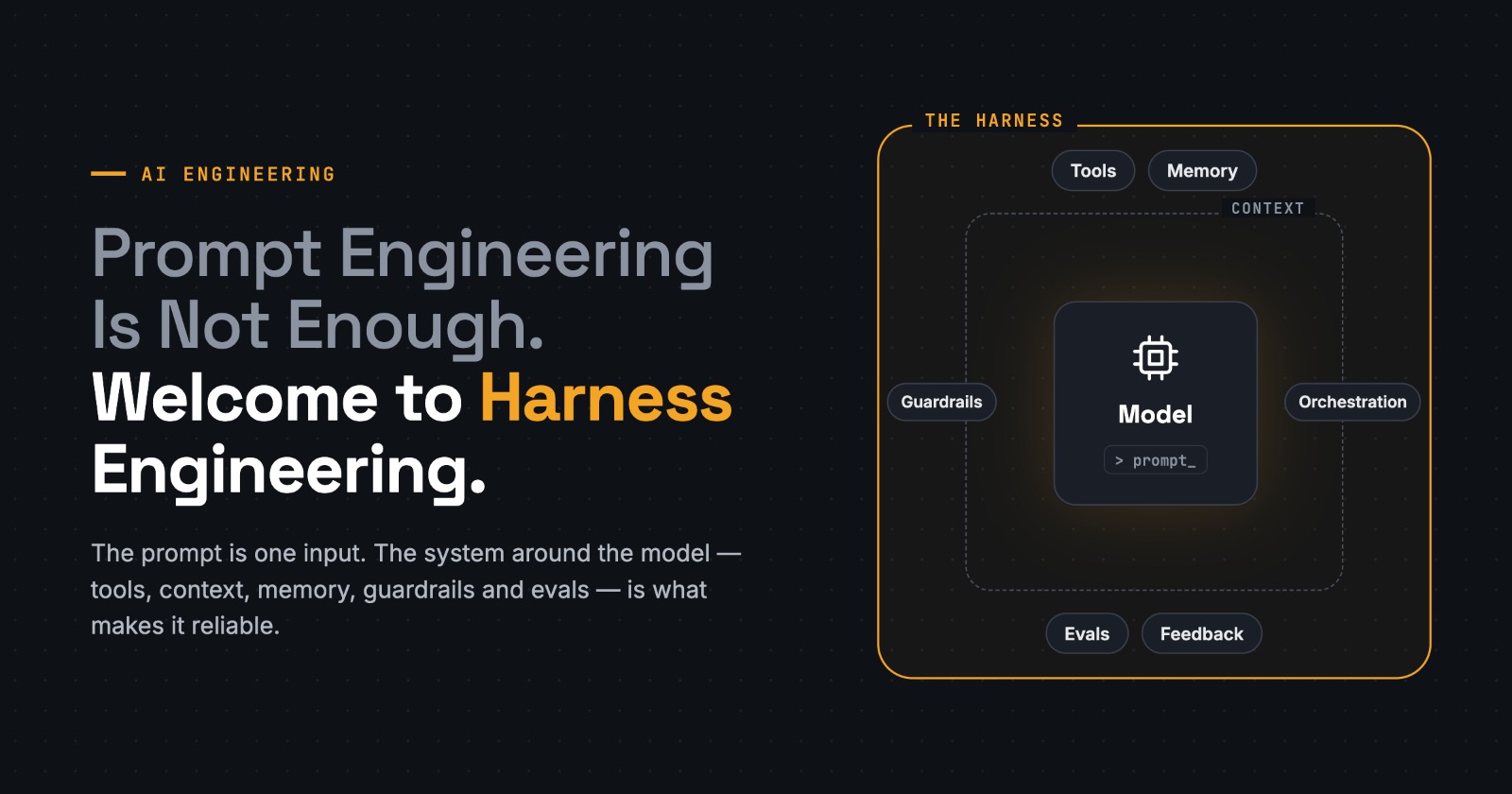
Prompt Engineering Is Not Enough: Welcome to Harness Engineering
Introduction
For a while, prompt engineering felt like the key to getting better results from artificial intelligence. Learn how to write clearer instructions, provide examples, define a role, and structure your requests, and an AI model could produce more useful responses. But AI is moving beyond answering individual questions. Modern AI agents are increasingly expected to work through multi-step tasks, use external tools, interact with applications, access information, write code, execute workflows, and recover from errors. In these situations, even a carefully written prompt cannot guarantee a reliable outcome. The challenge is no longer just telling an AI model what to do. It is designing the environment in which the model operates. This is where Harness Engineering comes in. Harness engineering focuses on the systems surrounding an AI model or agent: the context it receives, tools it can access, permissions it follows, workflows it executes, and feedback mechanisms that help verify its work. In this article, we explore why prompt engineering alone is not enough, what harness engineering means, how it differs from prompt and context engineering, and why it is becoming an important consideration for businesses building production-ready AI agents.
1. Why Prompt Engineering Is No Longer Enough
Prompt engineering changed how people interact with AI. Instead of submitting vague questions, users learned to provide context, define expectations, specify output formats, and break complicated requests into smaller instructions. These techniques remain useful, but the expectations placed on AI systems have changed. A simple chatbot may only need to generate a response. An AI agent, on the other hand, may need to understand a business objective, retrieve information from multiple sources, call APIs, update records, execute code, validate results, and decide what to do next. Consider asking an AI assistant to explain how to fix a software bug. That is primarily a response-generation task. Now consider asking an AI coding agent to investigate the bug, reproduce it, modify the code, run tests, inspect failures, update the implementation, and prepare a pull request. This is a much more complex workflow. A detailed prompt can describe the expected outcome, but it cannot independently provide the agent with access to the repository, a working test environment, the right tools, secure permissions, or a reliable way to verify that the bug has actually been fixed. This is the limitation of relying on prompts alone. As AI systems become more autonomous, the surrounding engineering environment becomes just as important as the instructions given to the model.
2. What Is Harness Engineering?
Harness Engineering is the practice of designing, building, and improving the systems around AI models and agents so they can perform tasks reliably, consistently, and within defined boundaries. An AI model provides the underlying reasoning and generation capabilities. The harness provides the environment that allows those capabilities to be applied to real tasks. It determines what information the agent receives, which tools it can use, how it performs actions, what constraints it must follow, and how its results are checked. Depending on the application, an AI agent harness may include: - System instructions and task-specific prompts. - Context retrieval and knowledge sources. - Tool integrations and API connections. - Memory and task-state management. - Workflow orchestration and execution controls. - Sandboxed environments for running code or actions. - Permissions, policies, and approval mechanisms. - Testing, validation, and evaluation systems. - Logging, monitoring, and error recovery. The important idea is that reliability does not come from the model alone. It comes from the model working inside a carefully designed system. Harness engineering shifts attention from simply improving individual prompts to engineering the complete environment that supports an AI agent.
3. Prompt Engineering vs Context Engineering vs Harness Engineering
Prompt engineering, context engineering, and harness engineering are related disciplines, but they address different layers of an AI system. Prompt Engineering: How should the AI be instructed? Prompt engineering focuses on designing the instructions provided to an AI model. It includes defining the task, setting expectations, providing examples, specifying constraints, and controlling the response format. Example: Asking an AI assistant to summarize a customer support conversation in five bullet points and identify unresolved issues. Context Engineering: What information should the AI receive? Context engineering focuses on selecting, organizing, and delivering the information an AI model needs at a particular point in a task. This can include documents, conversation history, retrieved knowledge, tool outputs, project files, and relevant system information. Example: Providing a customer support agent with the customer's account history, previous tickets, product documentation, and current subscription details before it prepares a response. Harness Engineering: What environment allows the AI to complete the task reliably? Harness engineering covers the broader system around the agent. It brings together instructions, context, tools, permissions, execution workflows, validation, monitoring, and recovery mechanisms. Example: Giving a support agent controlled access to customer records, allowing it to check an order, prepare a refund request, verify the refund rules, request approval when required, and record the completed action. These disciplines overlap. A well-designed harness uses effective prompts and context management, but also adds the operational and technical infrastructure required for multi-step work.
4. How an AI Agent Harness Works
An AI agent harness connects the model to the information, tools, and execution environment needed to complete a task. Instead of treating every interaction as a single prompt followed by a response, it manages a sequence of decisions and actions. A typical harness workflow may look like this: Step 1: Receive the Objective. The user or another system provides a goal, such as investigating a software issue or processing a customer request. Step 2: Prepare the Context. The harness gathers relevant instructions, documents, conversation history, system information, and task-specific data. Step 3: Identify the Next Action. The model uses the available context to determine what action may move the task forward. Step 4: Execute Through Approved Tools. The harness allows the agent to use permitted tools, such as APIs, databases, code execution environments, or search systems. Step 5: Observe the Result. Tool responses, errors, logs, and other outputs are returned to the agent as new context. Step 6: Validate Progress. The system checks whether the action produced the expected result and whether additional work is required. Step 7: Continue, Recover, or Escalate. The agent may continue with another action, retry after a recoverable failure, or request human assistance. Step 8: Confirm Completion. The system checks the completion criteria before reporting that the task is finished. This process creates a controlled execution loop. The exact architecture varies depending on the agent, application, tools, and level of autonomy.
5. Core Components of Harness Engineering
A reliable harness is made up of several components that work together. Not every AI application needs every component, but systems performing complex or high-impact tasks require more than a prompt and a model API. 1. Instructions and Policies: Define the agent's role, objectives, constraints, expected behaviour, and boundaries. 2. Context Management: Supplies relevant information from documents, databases, repositories, APIs, and conversation history without overwhelming the model with unnecessary data. 3. Tool Integration: Connects the agent to approved capabilities such as search, file access, code execution, ticket management, and business APIs. 4. Memory and State: Maintains the information needed across multiple steps, including task progress, previous decisions, and relevant observations. 5. Orchestration: Controls the sequence of activities, task delegation, tool execution, and transitions between workflow stages. 6. Execution Environment: Provides controlled environments in which agents can run code, inspect applications, or perform other operations. 7. Guardrails and Permissions: Restrict access and prevent unauthorized or unsafe actions. 8. Evaluation and Validation: Checks whether outputs and actions meet defined quality and completion criteria. 9. Observability and Recovery: Records execution details, identifies failures, supports debugging, and enables safe retries or escalation. Together, these components turn an AI model into a more capable and manageable application-level system.
6. Why Tools and Integrations Matter More Than Better Prompts Alone
AI agents become useful in business environments when they can interact with the systems where work actually happens. A model may understand how to create a support ticket, update a customer record, or retrieve an order status, but it cannot complete those actions without appropriate tool access. Tools give agents controlled ways to interact with external systems. Depending on the application, these tools may include: - REST APIs and GraphQL APIs. - Database query interfaces. - Internal enterprise applications. - CRM and customer support platforms. - Project management and ticketing systems. - File systems and document repositories. - Web browsers and search capabilities. - Code execution and testing environments. - Cloud infrastructure and deployment tools. For example, a project management agent may be asked to review a software release. It could retrieve open Jira issues, inspect pull request status, check test results, summarize blockers, and prepare a release report. Each activity requires an integration with the relevant system and appropriate permissions. A prompt can describe the desired result, but the harness makes the required actions possible. Tool design should also define input validation, output formats, error handling, access restrictions, and clear descriptions so the agent knows when and how to use each capability.
7. Context, Memory, and Knowledge Management in AI Harnesses
An AI agent can only make useful decisions when it has access to the information relevant to its task. However, providing every available document or conversation to the model is not a practical solution. Context must be selected, organized, updated, and delivered at the right time. A harness can use several context and memory mechanisms: Task Context: Information directly related to the current request, including requirements, instructions, and expected outcomes. Retrieved Knowledge: Relevant information fetched from documentation, databases, internal knowledge bases, or external sources. Conversation History: Previous exchanges that help the agent understand what has already been discussed or decided. Persistent Project Knowledge: Stable information such as architecture decisions, coding standards, product rules, and system documentation. Execution State: Information about completed actions, pending steps, errors, and the current status of a multi-step task. In software engineering, for example, an AI coding agent may need access to the repository structure, architecture documentation, API contracts, coding standards, and relevant test results. Without this context, it may generate code that looks reasonable but does not fit the existing application. Good context management also involves keeping information current. Outdated documentation, conflicting instructions, and excessive context can reduce the quality of an agent's decisions. The harness should help the agent discover the right information rather than simply supplying more information.
8. Guardrails, Permissions, and Safe Agent Execution
Giving an AI agent more capabilities also increases the importance of controlling what it can do. An agent that can read information, execute code, update records, or interact with production systems must operate within clearly defined boundaries. Harness engineering makes these boundaries part of the system design. Important safeguards include: Role-Based Access Control: Give agents access only to the systems and resources required for their assigned tasks. Least-Privilege Permissions: Avoid providing broad administrative access when a limited permission is sufficient. Human Approval: Require approval before sensitive actions such as issuing refunds, deleting records, changing access settings, or deploying to production. Sandboxed Execution: Run code and potentially risky operations in isolated environments rather than directly on critical systems. Input and Output Validation: Validate tool arguments, API responses, generated data, and other outputs before using them in subsequent operations. Audit Trails: Record important actions, tool calls, decisions, and approvals so teams can investigate what happened. Sensitive Data Protection: Apply appropriate controls to credentials, personal information, customer records, and confidential business data. These safeguards are particularly important when agents can take actions rather than simply generate recommendations. A reliable harness should make it clear which actions an agent can perform independently, which actions require approval, and which actions are never permitted.
9. Feedback Loops and Validation: How Agents Know Whether They Are Right
One of the biggest limitations of an AI-generated response is that it may sound convincing without being correct. In multi-step workflows, this problem can become more serious because one incorrect action may influence every step that follows. Harness engineering addresses this through feedback and validation mechanisms. For example, consider an AI coding agent asked to fix a login issue. The agent may inspect the code, identify a possible cause, modify the implementation, and report that the issue is fixed. But a successful code edit does not prove that the problem has been resolved. A reliable workflow should provide ways to: - Run unit and integration tests. - Execute relevant end-to-end test scenarios. - Check build and compilation results. - Inspect application logs and error messages. - Compare actual behaviour with acceptance criteria. - Review security and dependency checks. - Verify that the original issue can no longer be reproduced. The results should be returned to the agent so it can investigate failures and make corrections when appropriate. A useful feedback loop therefore contains an action, an observable result, a validation step, and a defined response to failure. The agent should not be allowed to declare success merely because it completed the action it was asked to perform. Completion should depend on evidence that the expected outcome has been achieved.
10. Observability, Error Handling, and Recovery in Agent Workflows
AI agents can perform multiple actions across different systems, making it difficult to understand what happened when a workflow fails. Without observability, teams may know that an agent did not complete a task but have little insight into where or why it failed. A well-designed harness should capture useful execution information, including: - Agent inputs and relevant context references. - Tool calls and their results. - Execution timestamps and task status. - Errors, timeouts, and failed operations. - Model usage and resource consumption. - Validation results and approval decisions. - Retry attempts and recovery actions. Error handling should also be designed deliberately. Some failures may be temporary, such as a network timeout. Others may indicate an invalid request, insufficient permissions, missing data, or an incorrect assumption. A harness can define different responses for different failure types. Temporary failures may allow a limited retry. Invalid inputs may require clarification. Permission errors may require escalation. Sensitive or irreversible actions may need to stop until a human reviews the situation. Observability helps engineering teams understand agent behaviour, improve workflows, investigate incidents, and identify recurring weaknesses. It is essential for moving from impressive demonstrations to systems that can be operated and maintained in production.
11. Harness Engineering in AI Coding Agents
Software development is one of the clearest examples of why harness engineering matters. AI coding agents are increasingly expected to work with entire repositories rather than generate isolated code snippets. A coding agent may need to understand the project architecture, locate relevant files, modify multiple components, execute tests, inspect failures, and prepare a pull request. To do this reliably, it needs more than a well-written coding prompt. An effective coding-agent harness may provide: Repository Awareness: Access to source code, project structure, architecture documentation, and relevant development instructions. Development Tools: Approved access to terminals, package managers, version control, test runners, and development utilities. Isolated Workspaces: Separate environments where changes can be made and tested without interfering with other work. Automated Validation: Build checks, linting, unit tests, integration tests, and other quality controls. Review Workflows: Mechanisms for examining code changes, incorporating feedback, and preparing pull requests. Observability: Access to logs, test outputs, application behaviour, and other evidence needed to investigate problems. In February 2026, OpenAI published an engineering account describing how its team used Codex in an agent-first development environment. The article highlighted repository knowledge, agent-accessible tools, automated review, application observability, and feedback loops as important parts of the approach. It illustrated how engineering work can shift towards designing the environment that allows agents to work effectively. The lesson is not that every team should remove human-written code. It is that AI coding agents need a carefully engineered environment if they are expected to handle complex development tasks.
12. Real-World Example: Building a Customer Support AI Agent
Imagine an e-commerce company that wants to automate common customer support requests. Customers regularly ask about order status, delivery delays, cancellations, refunds, and account information. A basic chatbot may answer questions using a prompt and a knowledge base. However, a more capable support agent needs to retrieve customer-specific information and perform certain actions under business rules. Without a Proper Harness: The agent may receive a customer request and generate a response based on the available conversation. It might not have access to the latest order information, may misunderstand refund eligibility, or could suggest an action that the business does not permit. With a Proper Harness: 1. The agent receives the customer's request. 2. The harness verifies the customer's identity through the approved authentication process. 3. The agent retrieves the relevant order information through a controlled API. 4. The harness provides the applicable refund and cancellation policies. 5. The agent evaluates the request against the available information. 6. The system checks whether the requested action is allowed. 7. If approval is required, the request is routed to an authorized employee. 8. Once approved, the relevant action is executed through the permitted integration. 9. The result is verified and recorded. 10. The agent provides the customer with an accurate status update. This example demonstrates that a useful business agent requires more than conversational intelligence. It needs reliable data access, policy enforcement, tool integrations, verification, and a clear process for handling exceptions.
13. Tools and Frameworks Used to Build AI Agent Harnesses
Harness engineering is not tied to a single framework or platform. Different tools can support different parts of the agent environment, and organizations often combine several technologies to create a complete solution. AI Models and Coding Agents: Models and agent products such as OpenAI models, Codex, Claude, and other AI systems provide reasoning, language understanding, and generation capabilities. Agent Development Frameworks: Frameworks and SDKs such as OpenAI Agents SDK, LangChain, LangGraph, and Microsoft Agent Framework can help developers structure agent workflows, tool use, and orchestration. Context and Knowledge Systems: Retrieval-augmented generation (RAG), vector databases, document stores, and search systems help agents access relevant information. Tool Integration Standards: APIs and protocols such as Model Context Protocol (MCP) can provide structured ways for AI applications to connect with external tools and data sources. Execution and Infrastructure: Containers, isolated workspaces, cloud platforms, and server-side execution environments provide controlled places for agents to perform tasks. Testing and Evaluation: Automated test frameworks, evaluation datasets, monitoring systems, and custom validation logic help teams assess agent behaviour and output quality. Observability: Logging, metrics, tracing, and dashboards help developers understand agent execution and investigate failures. The right technology stack depends on the use case, security requirements, scale, and existing infrastructure. Choosing a popular framework is not enough. Teams must understand how the components work together and how the overall system will be tested, secured, and maintained.
14. Key Benefits of Harness Engineering for Businesses
Harness engineering can help businesses move beyond isolated AI experiments and build systems that perform meaningful work within existing operations. 1. More Reliable Agent Workflows: Validation, error handling, and controlled execution can reduce the risk of incomplete or incorrect actions. 2. Better Use of AI Capabilities: Agents receive the context and tools needed to apply their capabilities to real business tasks. 3. Improved Operational Control: Permissions, approval gates, and execution limits help organizations manage agent autonomy. 4. Greater Transparency: Logs, traces, and task records make it easier to understand how an agent reached a result. 5. Easier Workflow Integration: Tool integrations allow agents to interact with existing business systems instead of operating as disconnected chat interfaces. 6. Better Maintainability: A structured harness provides a place to manage prompts, tools, policies, evaluations, and workflow changes. 7. Continuous Improvement: Feedback from failures and production usage can be used to improve the agent environment over time. 8. More Practical Automation: Businesses can explore multi-step workflows that combine information retrieval, decision support, and controlled actions. These benefits depend on implementation quality. A poorly designed harness can introduce complexity, latency, operational costs, and new failure points. Businesses should evaluate outcomes through measurable indicators rather than assuming that adding more agents or tools automatically improves performance.
15. Challenges and Limitations of Harness Engineering
Harness engineering introduces important design responsibilities. Building the surrounding system can be more complex than creating a prompt-based prototype, particularly when agents interact with multiple business applications. Integration Complexity: Connecting an agent to several APIs, databases, and enterprise systems requires careful design and maintenance. Context Quality: Incorrect, outdated, or incomplete information can lead to poor decisions even when the harness is technically sound. Security Risks: Every additional tool or integration can introduce access-control, data exposure, and operational risks. Workflow Complexity: Excessive orchestration, unnecessary agent handoffs, or poorly defined task boundaries can make systems harder to debug. Evaluation Difficulty: AI outputs are not always deterministic, making it important to define meaningful success criteria and test a range of scenarios. Latency and Cost: Multiple model calls, tool executions, retries, and evaluation steps can increase processing time and infrastructure costs. Maintenance Requirements: APIs, business rules, documentation, models, and tool capabilities change over time. The harness must evolve with them. Human Oversight: High-impact decisions may require human review, which means organizations must design clear escalation and approval processes. A successful implementation balances capability with simplicity. The objective is not to create the largest possible agent architecture, but to build the smallest reliable system that can complete the required tasks safely.
16. How to Start Building a Reliable AI Agent Harness
Organizations do not need to build a complex multi-agent platform from the beginning. A practical approach is to start with one clearly defined business workflow and gradually introduce the components required to make it reliable. Step 1: Choose a Specific Use Case. Identify a task with clear business value, such as preparing support ticket summaries, reviewing software issues, or retrieving information from internal documentation. Step 2: Define Success Criteria. Decide what a successful outcome looks like. Include measurable requirements such as accuracy, completion rate, response time, and policy compliance. Step 3: Select the Model. Choose a model based on the reasoning requirements, latency, cost, privacy, and deployment constraints of the use case. Step 4: Design the Context Layer. Identify the documents, data sources, instructions, and task information the agent needs. Step 5: Integrate the Required Tools. Connect only the systems and actions necessary for the workflow. Validate tool inputs and outputs. Step 6: Define Permissions and Guardrails. Establish which actions are allowed, which require approval, and which must be blocked. Step 7: Build the Execution Workflow. Define how the agent receives tasks, performs actions, observes results, handles errors, and determines completion. Step 8: Add Evaluation and Monitoring. Test the system with realistic scenarios, record execution details, and measure performance. Step 9: Run a Controlled Pilot. Start with limited users, restricted permissions, and human supervision. Step 10: Improve Based on Evidence. Review failures, user feedback, cost, and quality metrics before expanding the agent's capabilities. Starting small helps teams understand where the model performs well, where the harness needs improvement, and which activities should remain under human control.
17. Harness Engineering and Agentic AI: How Are They Connected?
Agentic AI refers to AI systems that can pursue goals through multiple steps, use tools, respond to changing information, and perform actions with varying levels of autonomy. Harness engineering focuses on designing the environment that makes these capabilities usable and controllable. An AI agent may contain a model that reasons about the next action. The harness provides the mechanisms through which that action is selected, executed, observed, and evaluated. For example, an agent may decide that it needs to retrieve information from a CRM system. The harness provides the approved CRM integration, checks the agent's permissions, executes the request, and returns the result. If the request fails, the harness helps determine whether the agent can retry, needs additional information, or should escalate the issue. The relationship can be understood simply: - Agentic AI describes the broader capability of AI systems to work towards goals through actions. - AI Agent is the application or system performing the task. - Harness Engineering is the practice of designing the supporting environment, controls, and execution mechanisms. A capable model may make an agent more intelligent, but a well-engineered harness helps make its actions more useful, observable, and manageable.
18. The Future of Harness Engineering
As AI agents become capable of handling longer and more complex tasks, the engineering around them is likely to become increasingly important. Organizations will need systems that can provide the right context, manage permissions, coordinate tools, verify outcomes, and recover from failures without requiring constant manual intervention. Several areas are likely to receive greater attention: More Capable Agent Runtimes: Development platforms may provide stronger support for task execution, memory, tool access, and workflow control. Automated Evaluation: Teams may increasingly use automated checks and evaluation datasets to assess agent performance across realistic scenarios. Improved Observability: Agent execution may become easier to inspect through structured traces, tool-call histories, metrics, and evidence of task completion. Policy-Based Autonomy: Organizations may define increasingly detailed rules for which tasks agents can perform independently and which require human approval. Self-Improving Workflows: Systems may use recurring failure patterns and evaluation results to identify weaknesses and suggest improvements to their own tools, context, or execution processes. Such changes should still be reviewed and controlled. Deeper Enterprise Integration: AI agents may become more closely connected to CRM platforms, internal applications, software development environments, and operational systems. The long-term direction is not simply to make AI models generate better responses. It is to build systems in which AI can complete useful work with clear boundaries, measurable outcomes, and appropriate accountability.
19. Why Harness Engineering Matters for Businesses Building AI Solutions
Businesses are moving beyond AI chat interfaces and exploring solutions that can participate in real operational workflows. Examples include customer support automation, internal knowledge assistants, document processing, software development agents, sales support, and enterprise workflow automation. These applications need to interact with business data and systems. They must follow company policies, respect user permissions, handle exceptions, and provide traceable results. A model that produces a convincing answer is not necessarily a system that can safely complete a business process. Harness engineering helps bridge this gap by connecting AI capabilities with application architecture, infrastructure, security, and operational requirements. For organizations building AI-powered products, this means thinking beyond model selection. The design should also address API integrations, data architecture, workflow orchestration, user experience, monitoring, scalability, and maintenance. Businesses exploring this approach can learn more about AI Software Development Services for integrating AI capabilities into software products and business workflows. Reliable agent systems may also depend on Cloud Solutions for infrastructure, deployment, and scalable operations.
20. Building the Right Technology Foundation for AI Agents
Harness engineering brings together multiple areas of software development. An AI agent may need a user interface, backend services, authentication, databases, external integrations, monitoring, and cloud infrastructure. These components must work together to provide a consistent and secure experience. For example, a business may build an AI-powered web application that allows employees to ask questions about internal policies. The frontend handles user interaction, backend services manage authentication and requests, a knowledge layer retrieves relevant documents, and the AI agent generates responses using the available context. Monitoring and access controls help ensure that users only receive information they are authorized to access. The same principles apply to mobile applications, enterprise platforms, and custom business systems. A reliable AI solution requires more than connecting a model API to a chat interface. Businesses developing these solutions can explore Web Development Services, Mobile App Development, and Bespoke Solutions to build application experiences and integrations around their business requirements. Organizations modernizing existing systems can also explore Digital Transformation Services to align AI adoption with broader technology and operational goals.
21. Frequently Asked Questions About Harness Engineering
1. What is harness engineering in AI? Harness engineering is the practice of designing and improving the systems around AI models and agents. It includes context management, tools, permissions, execution workflows, validation, monitoring, and recovery mechanisms. 2. How is harness engineering different from prompt engineering? Prompt engineering focuses on the instructions given to an AI model. Harness engineering covers the broader environment in which an AI agent operates, including its context, tools, execution process, safeguards, and feedback loops. 3. What is an AI agent harness? An AI agent harness is the software environment and supporting components that allow an AI agent to receive context, use tools, perform actions, maintain task state, and validate results. 4. Is context engineering part of harness engineering? Context engineering is closely related to harness engineering. It focuses on selecting and organizing information for the model, while the harness uses that context as part of a broader system that also manages tools, execution, permissions, and validation. 5. Why do AI agents need a harness? AI agents performing multi-step tasks need access to relevant information, approved tools, execution environments, and ways to verify their actions. A harness helps provide these capabilities within defined boundaries. 6. Does harness engineering improve AI accuracy? It can improve task reliability by providing relevant context, validation mechanisms, and feedback. However, it cannot guarantee that every model response or action will be correct. 7. What are the main components of an AI harness? Common components include instructions, context retrieval, tool integrations, memory, orchestration, execution environments, permissions, evaluation, observability, and error recovery. 8. Is harness engineering only for AI coding agents? No. It can be applied to customer support agents, research assistants, enterprise automation, document processing, data analysis, and other AI applications that perform multi-step tasks. 9. What tools are used in harness engineering? Depending on the application, teams may use agent SDKs, workflow frameworks, APIs, MCP integrations, databases, RAG systems, containers, automated testing tools, and observability platforms. 10. Can a business start harness engineering with a simple AI chatbot? Yes. A chatbot can be a starting point. As the application gains tool access, memory, workflow execution, or the ability to modify business data, the need for a more structured harness becomes increasingly important. 11. Does harness engineering eliminate human oversight? No. Human approval and review remain important for sensitive, high-impact, or irreversible actions. Harness engineering helps define where human involvement is required. 12. Is harness engineering a replacement for software engineering? No. It is an engineering discipline that builds on software development, system architecture, security, testing, and operations to support AI-powered applications.
Conclusion
Prompt engineering helped people communicate more effectively with AI models, but the rise of multi-step AI agents has introduced a broader engineering challenge. Agents need more than instructions. They need relevant context, reliable tools, controlled permissions, structured workflows, execution environments, and feedback mechanisms that help them understand whether their actions have worked. Harness engineering brings these elements together. It shifts the focus from simply asking an AI model to perform a task towards designing the complete system that allows it to perform that task responsibly. For businesses, this is an important step in moving from AI experiments to practical applications that interact with real systems and workflows. The future of AI will depend not only on how capable models become, but also on how well the systems around them are engineered.