
MCP Server Explained: How Model Context Protocol Servers Power Next-Generation AI Agents
Introduction
AI agents are becoming a core part of modern digital systems, helping businesses automate workflows, analyze data, and interact with users. However, as AI systems grow more complex, they need a standardized way to connect with tools, APIs, and data sources securely. This is where MCP servers (Model Context Protocol servers) come in. MCP servers act as a bridge between AI agents and real-world systems, enabling structured communication, secure integrations, and scalable automation. In this blog, we explore what MCP servers are, why they matter, and how BytesNBinary uses them to build intelligent AI solutions.
What Is an MCP Server?
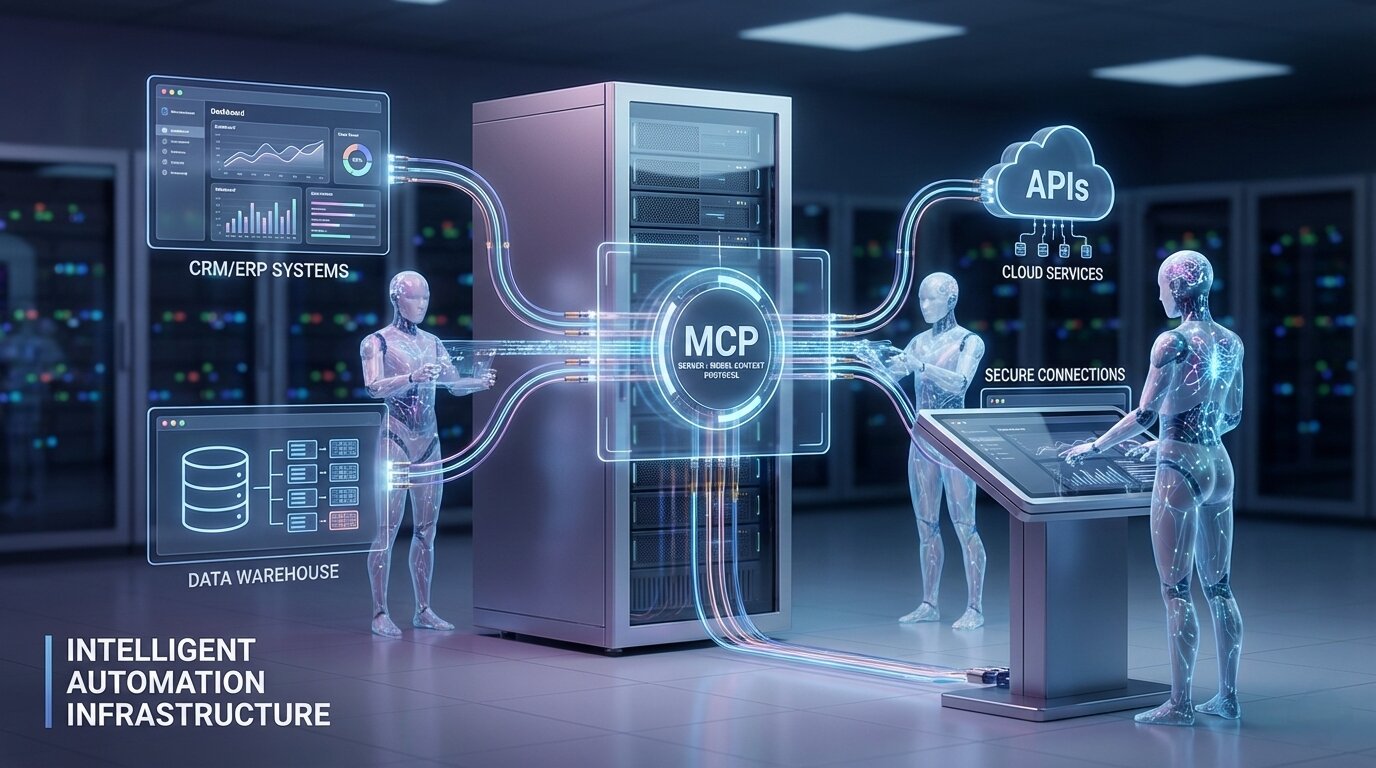
An MCP (Model Context Protocol) server is a system that allows AI agents to communicate with external tools, databases, and services in a structured and secure way. Instead of directly connecting to multiple APIs, AI agents interact with an MCP server that manages context, permissions, and data flow. This simplifies integrations and ensures safe communication between AI models and business systems.
Why MCP Servers Are Important for AI Agents
As AI agents handle tasks across multiple platforms, managing context and permissions becomes critical. MCP servers provide secure tool access, centralized data communication, structured workflows, controlled permissions, and scalable integrations. This allows AI agents to function reliably in enterprise environments.
Security and Control in MCP Servers
Security is a major concern when AI agents interact with business systems. MCP servers ensure authentication and authorization, encrypted data transfer, controlled API access, activity logging, monitoring, and auditing. These features protect sensitive data and maintain compliance.
Use Cases of MCP Servers in Business
MCP servers are used across industries to enable intelligent automation. Customer Support: AI agents access CRM data and support tools through MCP servers. Workflow Automation: Agents trigger tasks across multiple systems securely. Data Analysis: AI models retrieve structured data via MCP connections. SaaS Platforms: Multi-tenant systems manage AI integrations through MCP layers.
How BytesNBinary Uses MCP Servers
At BytesNBinary, MCP servers are implemented to build scalable AI automation solutions. Our team designs secure MCP architectures that allow AI agents to interact with business systems without exposing sensitive data. By combining structured context management, access control, and monitoring, we ensure that AI agents operate safely and efficiently across enterprise environments.
Benefits of MCP Servers
Secure AI integrations, centralized control, scalable architecture, better data management, reliable automation, and enterprise-ready AI systems make MCP servers essential for modern AI solutions.
Future of MCP Servers and AI Agents
As AI agents evolve, MCP servers will become a standard component of AI infrastructure. They will enable better interoperability, stronger security, and more scalable automation across industries. Businesses adopting MCP-based architectures will be better prepared for the future of AI-driven operations.
Conclusion
MCP servers are a key building block for modern AI systems. By enabling secure communication, structured integrations, and scalable automation, they help businesses deploy AI agents confidently. Companies investing in advanced AI infrastructure often combine MCP architectures with broader digital transformation services to modernize workflows, integrate intelligent automation, and build scalable enterprise systems. BytesNBinary leverages MCP server architecture to deliver intelligent automation solutions that are secure, reliable, and future-ready.