
The Future of Web Development in 2026: Beyond the Browser | Web & Software Development Services
Introduction
By 2026, web development has moved far beyond the limitations of traditional browsers, evolving into a core pillar of digital transformation services delivered by modern software development services providers. Today’s web experiences span devices, platforms, and environments—powered by AI, automation, and distributed architectures that enable applications to adapt intelligently to user behavior and context. Leading IT service companies and web application development companies are no longer focused solely on building websites. Instead, they are engineering intelligent ecosystems that combine performance, scalability, and seamless user interaction across web, mobile, and cloud platforms. These experiences integrate AI-driven logic, real-time data, and automation to support the growing demands of businesses operating in a digital-first economy. As the lines between digital and physical experiences continue to blur, the future of web development lies in building flexible, intelligent systems that support SaaS application development, full stack development services, and long-term business innovation. This evolution requires new architectural thinking, ethical considerations, and technical expertise to deliver web solutions that are not only functional—but truly future-ready.
Ambient AI Interfaces
AI in 2026 has moved beyond being a tool for developers to becoming the foundational layer of the user experience itself. Ambient AI interfaces create web experiences that adapt in real-time to user behavior, environmental context, and predictive needs without explicit commands. These systems employ multimodal understanding—processing voice, gaze, gesture, and even biometric signals—to create fluid, conversational interfaces that feel less like using software and more like interacting with an intelligent environment. The web is becoming anticipatory, with AI agents that understand intent and orchestrate complex workflows across applications and devices, fundamentally changing how users accomplish tasks and access information.
Autonomous Web Agents
Web applications in 2026 deploy persistent AI agents that act on users' behalf across sessions and contexts, learning preferences and automating routine interactions while maintaining user control and transparency.
Spatial Web Development
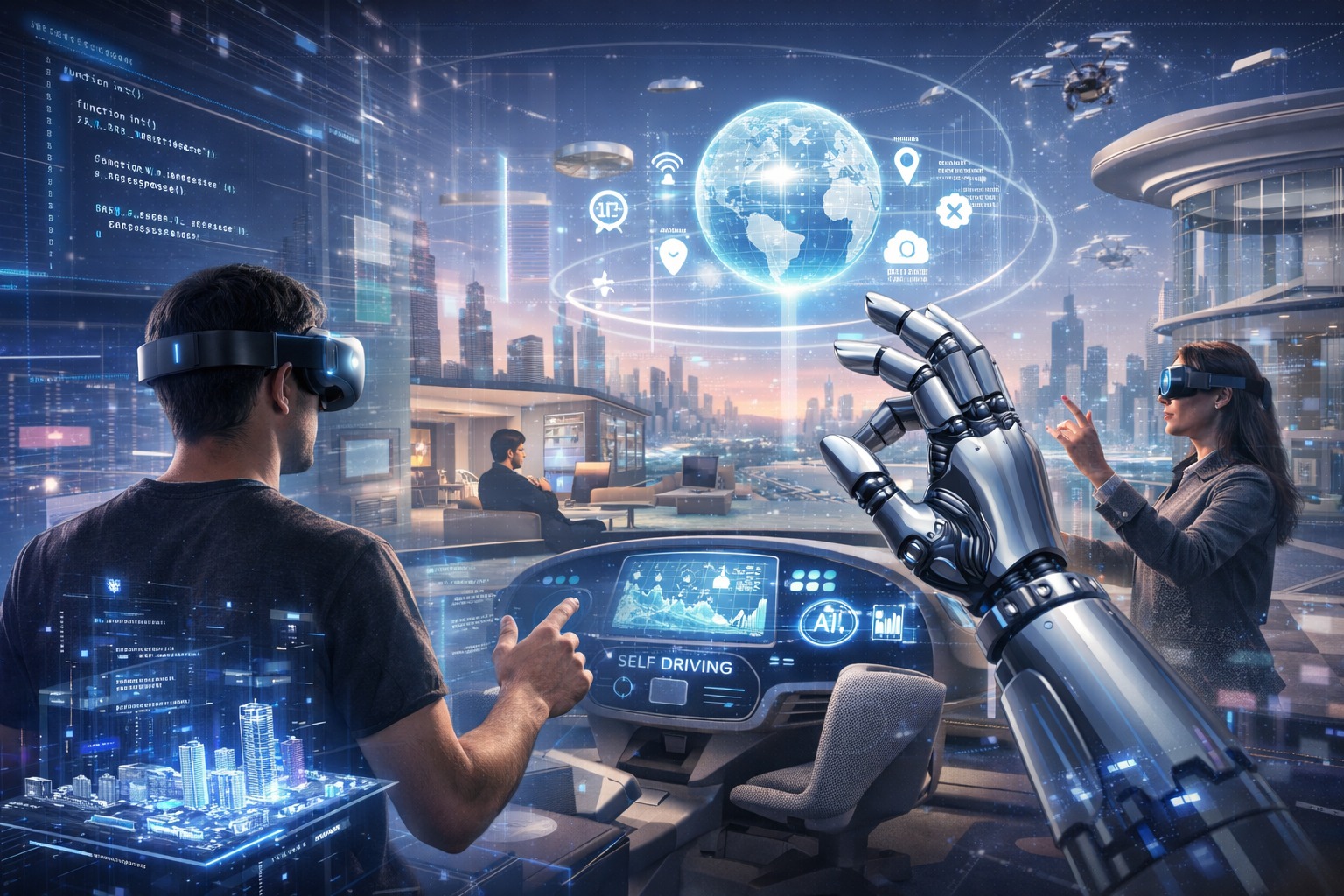
The Spatial Web—where digital content exists persistently in physical space—has moved from experimental to mainstream by 2026. Web developers are creating experiences that users access through AR glasses, VR headsets, and spatial projection systems, using WebXR standards that have matured into robust platforms. These spatial interfaces demand new design principles: three-dimensional information architecture, physics-based interactions, and environmental awareness. The challenge is no longer just responsive design for different screen sizes, but responsive presence for different physical contexts—from crowded urban environments to private workspaces to public installations.
Distributed Edge-First Architecture
The centralized cloud model is giving way to truly distributed architectures that push computation, storage, and intelligence to the network's edge—and beyond to client devices. Web applications in 2026 are engineered as federated systems where different components run optimally across edge nodes, user devices, and specialized processing units. This shift enables near-zero-latency interactions, enhanced privacy through local processing, and resilience through geographic distribution. The development paradigm has shifted from 'deploying to servers' to 'orchestrating across environments,' requiring new tools for synchronization, conflict resolution, and distributed state management.
The Biometric Web
Web authentication and personalization in 2026 have moved beyond passwords and cookies to continuous, passive biometric verification. Applications can identify users through behavioral patterns (typing rhythm, interaction timing), physiological responses (heart rate variability via camera), and device-specific signatures, creating both unprecedented convenience and significant ethical challenges. This biometric layer enables hyper-personalized experiences that adapt not just to who you are, but to your current cognitive state, emotional tone, and attention level. The development challenge lies in implementing these capabilities responsibly—with explicit consent, transparent data usage, and robust security for highly sensitive biometric data.
Sustainable Computing by Default
As digital infrastructure's environmental impact becomes impossible to ignore, sustainable computing has moved from optional best practice to non-negotiable requirement. Web development in 2026 incorporates energy efficiency, carbon awareness, and computational minimalism into every layer of the stack. Applications dynamically adjust their resource consumption based on local energy sources (prioritizing renewable), network conditions, and device capabilities. Developers are measured not just on feature velocity and performance, but on carbon budgets and energy efficiency scores. This shift requires new metrics, tooling, and architectural patterns that prioritize doing more with less computational overhead.
Conclusion
The web of 2026 is an intelligent, spatial, and distributed fabric that weaves together digital and physical realities. Developers are no longer just builders of isolated applications but architects of experiential ecosystems that learn, adapt, and exist across multiple planes of interaction. This future demands not just technical skills in new frameworks and protocols, but ethical frameworks for responsible AI, privacy-first design principles, and sustainability-conscious architectures. The most successful teams will be those that balance technological capability with human-centered values, creating experiences that enhance rather than replace human agency. As the web continues its evolution from document platform to application platform to experiential platform, the fundamental question shifts from 'what can we build?' to 'what should we build?' and 'for whose benefit?' Navigating this future requires technical excellence, ethical clarity, and the humility to build for a world where our creations increasingly mediate human experience, connection, and understanding.