
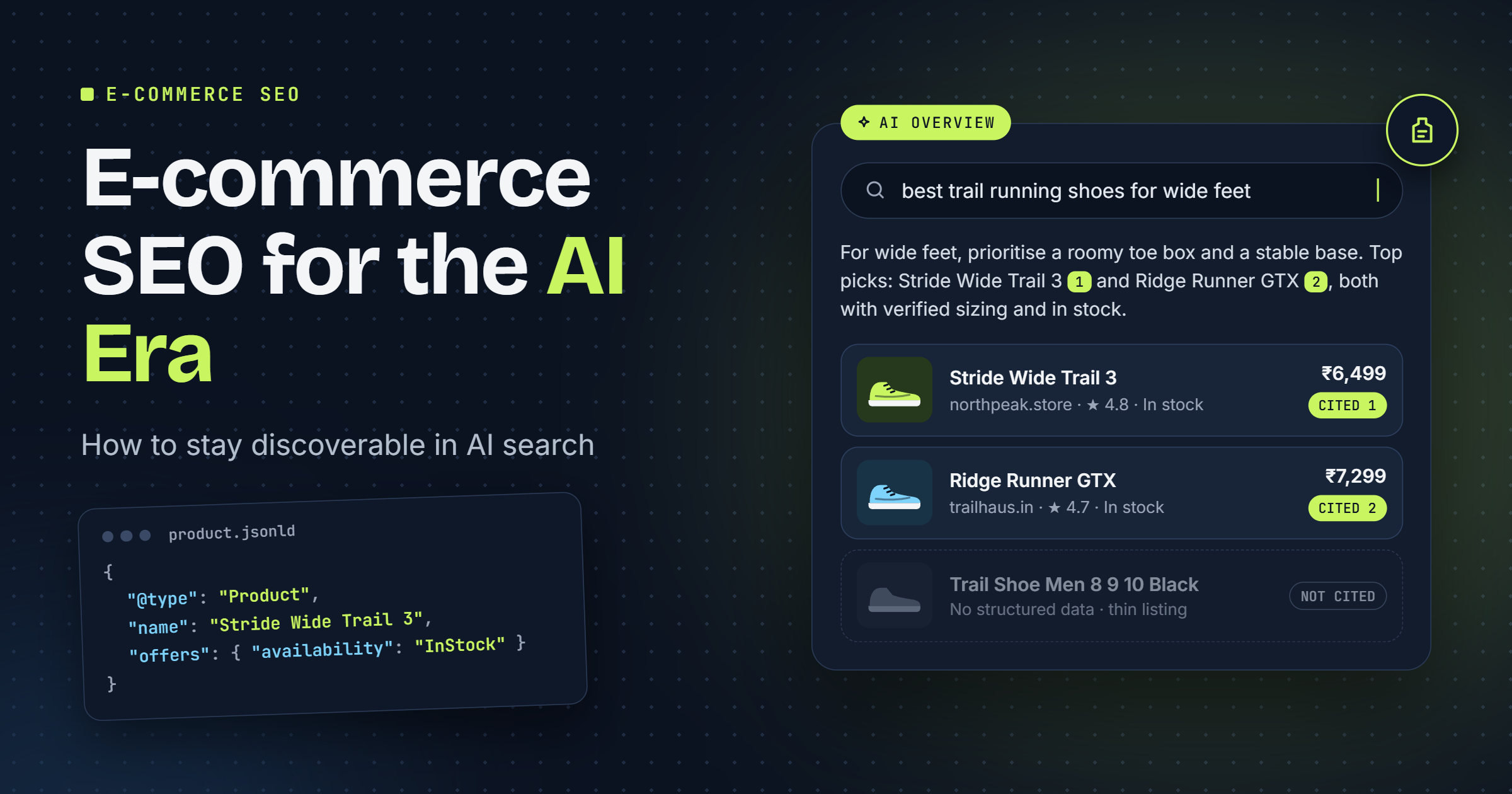
E-commerce SEO in the AI Era: How AI Search Is Changing Product Discovery
Introduction
The way people discover products online is changing. For years, e-commerce SEO focused primarily on ranking product pages for keywords, appearing on search engine results pages, and driving users from search results to an online store. That model is now evolving. AI-powered search and shopping experiences can understand conversational queries, compare product information, interpret preferences, and help shoppers narrow down their choices. Instead of searching for a simple keyword such as "best running shoes," a customer might ask for "lightweight running shoes under ₹5,000 that are suitable for daily running and occasional trails." This shift creates a new challenge for e-commerce businesses: how do you make sure your products are not only visible in traditional search results but also understandable and discoverable within AI-powered search experiences? The answer is not to abandon traditional SEO. Instead, businesses need to build on strong SEO foundations while improving product information, structured data, technical accessibility, product feeds, customer reviews, conversational content, and overall digital authority. E-commerce SEO in the AI era is becoming less about matching individual keywords and more about helping search engines and AI systems understand what a product is, who it is for, what makes it useful, and why a customer might choose it.
1. What Is E-commerce SEO in the AI Era?
E-commerce SEO in the AI era is the process of optimizing an online store so that products, categories, content, and business information can be discovered and understood across traditional search engines and AI-powered search experiences. Traditional SEO still matters. Websites need to be crawlable, pages need to be indexable, content needs to satisfy user intent, and technical performance still influences the overall search experience. However, e-commerce businesses now have another layer to consider: how clearly can machines understand their product catalog? AI-powered search depends heavily on context. A product page that simply contains a product name and a few generic marketing sentences may not provide enough useful information to understand the product's features, intended audience, use cases, specifications, pricing, availability, and differences from competing products. A stronger AI-era ecommerce SEO strategy therefore combines technical SEO, high-quality product content, structured product information, trustworthy reviews, accurate feeds, and helpful buying content. The goal is not to create content specifically for machines at the expense of people. The goal is to make product information clear enough for both.
2. How AI Search Is Changing Product Discovery
Traditional search generally requires users to enter a query, review a list of results, visit multiple websites, compare products, and decide what to purchase. AI-powered search can make the discovery process more conversational. A customer can describe a problem, preference, budget, or use case and expect the system to help narrow down relevant options. For example, instead of searching for "office chair," a shopper might ask, "What is a comfortable ergonomic chair for someone who works from home for eight hours a day and has a budget of ₹15,000?" The difference is significant because the query contains context and intent rather than a single keyword. AI shopping experiences can also help customers compare products and evaluate trade-offs. This means ecommerce businesses need to think beyond keyword rankings. Product visibility increasingly depends on whether the available information is detailed, accurate, structured, and relevant enough to support product discovery. Businesses that provide clear product attributes, useful descriptions, accurate prices, availability, images, reviews, and supporting content are better positioned to participate in this evolving discovery journey.
3. Traditional SEO vs AI Search Optimization
AI search does not mean that traditional SEO is obsolete. Strong technical SEO, crawlability, indexability, internal linking, content quality, page experience, and authority remain important foundations. What changes is the scope of optimization. Traditional SEO often asks whether a page can rank for a particular keyword. AI-era ecommerce SEO asks a broader question: can a search system understand this product well enough to identify it as a useful answer for a specific customer need? Consider a product page for a laptop. Traditional optimization may focus on keywords such as "best laptop," "business laptop," or "laptop under ₹60,000." AI-oriented optimization also considers whether the page clearly explains processor, RAM, storage, display, battery, operating system, intended use, connectivity, warranty, and other relevant attributes. The strongest approach is therefore not SEO versus AI SEO. It is SEO plus better product information. Businesses should continue optimizing for search engines while making their content and product data more precise, complete, accessible, and useful.
4. Why Product Data Matters More Than Ever
Product data is becoming one of the most important foundations of ecommerce visibility. Search engines and AI-powered shopping systems need reliable information to understand what a product is and whether it matches a customer's requirements. Important product information can include product name, brand, description, price, availability, product identifiers, category, size, color, material, dimensions, specifications, images, shipping information, return policies, and customer reviews. Inconsistent information can create problems. For example, if a product page displays one price while another product data source contains an outdated price, the overall shopping experience can become confusing. The same applies to inventory, product variants, shipping conditions, and product specifications. E-commerce businesses should therefore treat product data as a business asset rather than simply website copy. Product information should be accurate, consistent, regularly updated, and presented in a way that both customers and technology platforms can understand.
5. How to Optimize Product Pages for AI Search
A product page should answer the questions a customer would naturally ask before making a purchase. Start with a clear product title that describes the actual product and important identifying attributes without keyword stuffing. Write factual descriptions that explain what the product does, who it is designed for, its major features, its use cases, and what differentiates it from alternatives. Include detailed specifications instead of hiding important information inside images. Product variants such as size, color, capacity, configuration, or material should be clearly represented. Add useful information about shipping, returns, warranty, compatibility, installation, maintenance, or usage whenever relevant. Product FAQs can also help answer common buying questions. Images should clearly represent the product and should have meaningful alternative text where appropriate. Most importantly, avoid generic descriptions copied across dozens of product pages. Unique, useful, factual product information gives both customers and search systems more context to work with.
6. Use Structured Data to Help Search Engines Understand Products
Structured data provides machine-readable information that helps search engines understand the meaning of important content on a webpage. For ecommerce websites, product structured data can communicate information such as product name, brand, offers, price, availability, reviews, ratings, shipping details, and return information when supported and implemented correctly. Structured data should not be treated as a shortcut to guaranteed rankings or AI recommendations. Instead, it should be viewed as part of a broader technical SEO strategy. The visible content on the page should accurately match the structured information. If a product is out of stock, the data should not incorrectly indicate that it is available. If the price changes, the relevant information should be updated. Consistency between the webpage, structured data, product feed, and other catalog sources is important. A technically sound implementation can make product information easier for search engines to interpret and can support richer search experiences.
7. Why Product Feeds Are Becoming a Critical Discovery Layer
E-commerce businesses often think of their website as the only source of product information. In modern shopping ecosystems, that is no longer enough. Product feeds can provide structured catalog information to shopping platforms and AI-powered commerce experiences. A well-maintained feed can include product identifiers, titles, descriptions, URLs, images, pricing, availability, variants, seller information, shipping, and other relevant attributes. The importance of product feeds is increasing as AI-powered shopping experiences need reliable catalog information to understand and surface products. This creates another responsibility for ecommerce teams: keep feeds accurate and synchronized with the actual store. An outdated feed can result in incorrect prices, unavailable products, missing variants, or inaccurate descriptions being surfaced to potential customers. Businesses should therefore include product feed management as part of their broader ecommerce SEO and digital commerce strategy.
8. Keep Product Prices, Inventory, and Variants Accurate
Accuracy is becoming increasingly important as shoppers rely on search platforms and AI systems to compare products. Imagine a customer discovers a product through an AI-powered shopping experience, only to find that the displayed price is outdated or the selected size is unavailable after reaching the website. That disconnect creates friction and can damage trust. Ecommerce businesses should establish processes to keep product pricing, inventory, variants, promotions, shipping information, and return policies synchronized across their website and connected commerce platforms. Product variants should be clearly modeled so that each purchasable option has the correct price, availability, image, and relevant attributes. Regular catalog synchronization can reduce discrepancies. Businesses should also monitor feed errors and product data warnings rather than treating the feed as a one-time setup. In the AI era, maintaining accurate product information is not just a technical responsibility. It is part of the customer experience.
9. Optimize for Conversational and Long-Tail Search Queries
AI search makes conversational queries more important. Customers are no longer limited to short keyword combinations. They can describe what they want in natural language. This creates opportunities for ecommerce businesses to address detailed questions and long-tail search intent. Instead of targeting only "running shoes," a brand can create useful content around questions such as "Which running shoes are suitable for beginners?", "What is the difference between trail running shoes and road running shoes?", or "How should I choose the right running shoe size?" Product pages should also naturally answer relevant questions about compatibility, sizing, materials, performance, use cases, and maintenance. The objective is not to fill pages with every possible keyword variation. It is to understand what customers are trying to accomplish and provide the information needed to make a confident decision. Conversational search rewards businesses that understand customer intent rather than simply repeating exact-match keywords.
10. Why Reviews and Reputation Matter in Product Discovery
Customer reviews provide information that product descriptions often cannot. A product page can explain technical specifications, but reviews can reveal how the product performs in real-world situations. Customers may mention comfort, durability, fit, installation experience, ease of use, battery performance, quality, or other practical considerations. Genuine reviews can therefore provide additional context for both customers and search systems. Ecommerce businesses should make it easy for customers to leave authentic feedback and should display reviews clearly on relevant product pages. Businesses should never manufacture reviews or manipulate ratings. Instead, they should focus on building products and customer experiences that naturally generate useful feedback. Review content can also reveal recurring questions and concerns. Those insights can be used to improve product descriptions, FAQs, buying guides, and customer support content.
11. Create Content Around the Entire Buying Journey
Product pages are only one part of an ecommerce content strategy. Customers need different types of information at different stages of the buying journey. At the awareness stage, they may search for educational guides, product categories, or solutions to a problem. During consideration, they may compare brands, features, specifications, prices, and alternatives. At the decision stage, they may look for detailed reviews, sizing guides, product demonstrations, warranty information, or answers to specific questions. Ecommerce websites can create content for each stage. A clothing store could publish guides about choosing fabrics, sizing, styling, and care. A technology retailer could create comparisons, buying guides, setup tutorials, and product explainers. This supporting content creates a stronger information ecosystem around the product catalog. It also gives search engines and AI systems more useful context about the topics, products, and customer needs associated with the business.
13. Don't Ignore Shopping Platforms and Merchant Data
Ecommerce SEO should extend beyond the website. Shopping platforms and merchant systems can provide additional discovery opportunities for products. Businesses should maintain accurate product titles, descriptions, images, pricing, availability, identifiers, shipping information, and other relevant attributes across their commerce ecosystem. Product information submitted to shopping platforms should closely match the information presented on the website. This is particularly important when customers move between search results, shopping experiences, AI recommendations, and the merchant website. Businesses should regularly review product feed diagnostics, disapproved products, missing attributes, outdated information, and inventory mismatches. The broader lesson is simple: ecommerce visibility depends on more than optimizing one webpage. A product needs a consistent digital identity across the different systems that help customers discover and evaluate it.
14. Prepare Your Ecommerce Website for AI-Powered Shopping and Agents
The next stage of ecommerce search may involve AI systems doing more than helping users find information. AI-powered shopping experiences can increasingly help customers compare options, understand trade-offs, and move closer to purchase decisions. This makes website accessibility and structured product information even more important. Ecommerce websites should have stable product URLs, clear navigation, accessible content, accurate product attributes, structured data, understandable checkout flows, and clearly documented shipping and return policies. Product variants should be represented consistently. Technical restrictions that prevent legitimate systems from accessing important product information should also be reviewed as part of a broader technical SEO strategy. Businesses should not build their entire strategy around one AI platform. Instead, they should create a strong digital commerce foundation that makes their catalog understandable across search engines, shopping platforms, AI assistants, and other discovery channels.
15. How to Measure E-commerce Visibility in the AI Era
Measuring ecommerce SEO should go beyond traditional keyword rankings. Businesses should continue monitoring organic impressions, clicks, rankings, click-through rates, conversion rates, revenue, and product-level performance. At the same time, they should begin paying attention to how their products and brand appear across AI-powered search and shopping experiences. Useful areas to monitor include referral traffic from AI platforms, product feed health, shopping impressions, product clicks, conversion behavior, brand mentions, product recommendations, and customer journeys that begin with conversational discovery. It is also useful to track technical issues such as broken product URLs, missing structured data, incorrect availability, outdated prices, and feed errors. AI search measurement is still evolving, so businesses should avoid relying on a single metric. The better approach is to combine traditional SEO data, ecommerce analytics, product feed performance, conversion data, and emerging AI visibility signals.
16. The Future of E-commerce SEO: From Rankings to Recommendations
The future of ecommerce SEO is unlikely to be about choosing between traditional search and AI search. Instead, businesses will need to optimize for a broader product discovery ecosystem. Search engines will continue to provide traditional results and increasingly AI-generated experiences. Shopping platforms will continue to organize product catalogs. AI assistants will help users describe their needs, compare options, and discover products. In this environment, the most valuable ecommerce assets will be accurate product information, trustworthy content, strong technical foundations, high-quality customer experiences, structured data, reliable product feeds, and recognizable brand authority. The question businesses ask may gradually change from "How do I rank number one for this keyword?" to "How do I make sure my product is the best understood and most relevant answer when a customer asks for something I sell?" That does not make SEO less important. It makes good SEO more comprehensive.
Conclusion
E-commerce SEO is entering a new phase. AI-powered search is changing how customers discover, compare, and evaluate products, but the fundamentals of good SEO remain important. What is changing is the amount and quality of information businesses need to provide. Product pages need to be useful. Product data needs to be accurate. Structured data needs to be implemented correctly. Product feeds need to stay synchronized. Reviews need to be genuine. Content needs to answer real customer questions. Technical SEO needs to make important information accessible. Most importantly, businesses need to think beyond individual keywords and focus on the complete product discovery journey. The brands that adapt successfully will not be the ones searching for shortcuts to AI visibility. They will be the ones building trustworthy, detailed, technically sound, and customer-focused digital commerce experiences. AI search is not eliminating ecommerce SEO. It is expanding what ecommerce SEO needs to accomplish.