
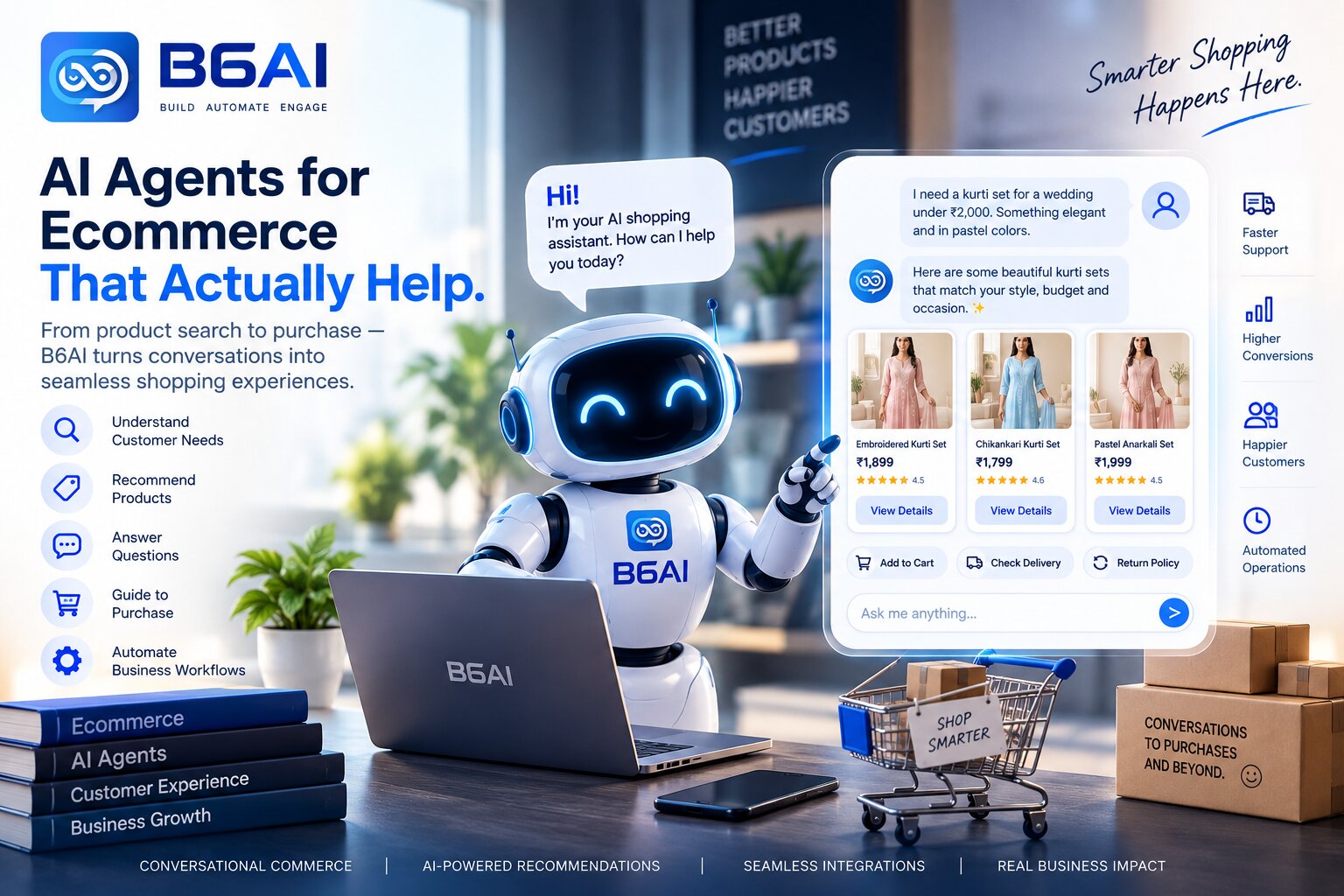
B6AI: How AI Agents Are Transforming Ecommerce From Product Search to Purchase
Introduction
Online shopping has become faster and more convenient, but the ecommerce customer journey can still involve too many steps. Customers search for products, apply filters, compare options, read product descriptions, check availability, ask questions, review shipping information, and finally complete checkout. AI agents are changing this experience by allowing customers to communicate what they need naturally instead of navigating every step manually. An AI agent can understand customer intent, recommend relevant products, answer questions, retrieve information, and trigger business workflows when connected to the right systems. This shift is creating a new model of conversational commerce where the customer can simply explain what they want and let an intelligent system help them move toward a purchase. To help businesses build these intelligent experiences, BytesNBinary developed B6AI, an AI-powered Bot Builder designed to connect conversational AI with knowledge, workflows, and business processes.
Why Online Shopping Still Has Too Much Friction
Traditional ecommerce platforms have optimized the shopping journey around search, categories, filters, product pages, carts, and checkout. These systems work well when customers know exactly what they want. However, many customers begin with a problem rather than a product name. A customer may say, "I need a comfortable dress for a wedding under ₹3,000," or "I need a laptop for programming under ₹70,000." Finding the right product can require multiple searches and comparisons. Every additional step creates another opportunity for the customer to leave the website. AI agents can reduce this friction by turning product discovery into a natural conversation.
What Is an AI Agent for Ecommerce?
An AI agent for ecommerce is an intelligent software system that can understand customer requests, reason about what the customer needs, retrieve relevant business information, and perform or trigger actions through connected systems. Unlike a basic rule-based chatbot, an AI agent can work with natural language and conversational context. It can help customers discover products, answer product questions, provide recommendations, explain policies, assist with order-related requests, and guide customers through different stages of the buying journey.
AI Agent vs Traditional Ecommerce Chatbot
A traditional ecommerce chatbot generally works through predefined questions and responses. A customer may need to select an option such as Track Order, Return Order, or Contact Support. An AI agent can understand a more natural request such as, "My order has not arrived yet. Can you check what happened?" and determine what information or workflow is required. The difference is that an AI agent is designed around customer intent and tasks rather than only predefined conversation paths.
The Shift From Keyword Search to Intent-Based Shopping
Traditional ecommerce search depends heavily on keywords. Customers may search for specific product names, categories, colors, sizes, or specifications. However, customers often describe their requirements differently from the way products are listed. An AI shopping assistant can interpret the underlying intent behind a request. Instead of requiring a customer to know the exact product terminology, the customer can describe the problem they want to solve, their preferences, and their budget. The AI can then use that information to guide product discovery.
AI-Powered Product Recommendations
Product discovery is one of the most valuable applications of AI in ecommerce. An AI agent can ask relevant questions about budget, preferences, use case, size, features, color, or other requirements before suggesting products. For example, a customer looking for a wedding outfit may not know which category to choose. Instead of navigating multiple filters, the customer can describe the occasion and preferences in a conversation. The AI can use the available product information to present relevant options and explain why they may match the customer's requirements.
Customers Can Get Product Answers Instantly
Customers often delay purchases because they have unanswered questions. They may want to know whether a product is available in a particular size, what material it uses, how long delivery takes, whether it can be returned, or how two products differ. An AI agent connected to accurate product and business information can provide these answers during the conversation. Instead of making customers search through product pages, FAQs, and policy documents, the information can be delivered within the same conversational experience.
From Customer Support Bot to AI Sales Assistant
The role of ecommerce AI can extend beyond customer support. An AI agent can act as a conversational sales assistant by helping customers discover products, compare options, understand features, and move toward a purchasing decision. A customer might say, "I need a phone for photography under ₹40,000." The AI can understand the requirements, identify relevant products, explain differences, answer follow-up questions, and guide the customer toward the next step. This creates a more interactive buying experience than a conventional FAQ chatbot.
AI Agents Can Automate More Than Customer Conversations
Ecommerce businesses have many repetitive processes beyond customer support. AI agents can assist with product discovery, lead qualification, order-related questions, returns, refunds, customer notifications, internal requests, knowledge retrieval, and workflow automation. The exact level of automation depends on the systems and APIs connected to the AI agent. When the agent can securely interact with business systems, it can become part of the operational workflow rather than remaining a standalone chat interface.
The Real Power Comes From Ecommerce Integrations
An AI model by itself does not know an ecommerce business's products, inventory, orders, customers, or policies. It needs access to relevant information and business tools. An ecommerce AI architecture may connect the conversational agent with product catalogs, inventory systems, customer data, order management, CRM platforms, shipping systems, payment infrastructure, and knowledge bases. These integrations allow the AI to provide more useful and contextual responses while enabling workflows that go beyond simple conversation.
From Product Search to Purchase
One of the biggest opportunities for AI agents is reducing the distance between customer intent and purchase. A customer may begin by saying, "I want a black party-wear dress under ₹3,000." The AI can understand the requirement, present matching products, answer questions, check available variants, provide relevant delivery information, and guide the customer toward checkout when the required ecommerce integrations are available. The goal is not simply to automate the conversation. The goal is to make the entire shopping journey easier and more intuitive.
AI Can Make Ecommerce More Personalized
Personalization in ecommerce traditionally depends on browsing behavior, purchase history, recommendations, and predefined customer segments. Conversational AI introduces another layer of personalization because customers can directly communicate their requirements. An AI agent can use information from the current conversation to understand preferences and narrow down relevant options. For businesses, this creates an opportunity to make product discovery feel more like speaking with a knowledgeable sales assistant.
What Is B6AI Bot Builder?
This is where BytesNBinary's B6AI Bot Builder comes into the picture. B6AI is an AI-powered Bot Builder designed to help businesses create, deploy, and manage intelligent conversational assistants. The platform is designed around the idea that modern AI assistants should do more than provide predefined responses. They should be able to work with knowledge, conversations, workflows, and business processes to create useful experiences for customers and organizations.
How B6AI Can Help Ecommerce Businesses
An ecommerce business can use B6AI to create an AI-powered conversational experience for customers. Instead of forcing customers to navigate multiple pages before finding the right product, a B6AI-powered assistant can understand what they are looking for and guide them through the discovery process. The conversation can include product questions, recommendations, business policies, customer support, and other workflows based on the information and integrations available to the business.
A Possible B6AI Ecommerce Customer Journey
A conversational ecommerce journey can begin with a simple customer request. The customer explains what they need, and the B6AI-powered agent interprets the intent. The agent can then retrieve relevant knowledge, identify suitable products, answer questions, and guide the customer toward the next action. With appropriate integrations, the workflow can continue into availability checks, order processes, and post-purchase support. The result is a conversational layer that can connect different stages of the customer journey.
The Goal Is Not Just AI. It Is Less Friction.
The value of an ecommerce AI agent should not be measured simply by whether a business has added AI to its website. The more important question is whether the technology makes the customer's journey easier. If a customer can explain what they need, receive relevant options, get answers to their questions, and move toward a purchase without unnecessary navigation, AI is solving a real ecommerce problem. The objective should be to remove friction rather than add another technology layer.
AI Agents Do Not Have to Replace Ecommerce Websites
AI agents do not necessarily replace traditional ecommerce websites. Instead, they can become another interface through which customers interact with the business. Customers who prefer browsing can continue using categories, search, filters, and product pages. Customers who prefer conversation can interact with an AI shopping assistant. Businesses can support both experiences while using AI to provide another path toward product discovery, customer support, and purchase.
What Ecommerce Businesses Need Before Implementing AI
Successful ecommerce AI implementation requires more than connecting a language model to a website. Businesses need accurate product data, structured knowledge, reliable APIs, secure integrations, clear workflows, access controls, monitoring, and appropriate human escalation. Product descriptions, prices, variants, policies, and availability should be maintained accurately. AI should also have clearly defined permissions so that it can access only the information and systems required for its tasks.
AI Should Know When to Involve a Human
Automation does not mean every customer interaction should be handled entirely by AI. Complex complaints, unusual requests, sensitive issues, payment disputes, and situations requiring human judgment may need to be transferred to a support representative. A well-designed ecommerce AI experience should therefore include human escalation. The AI should assist customers where automation works well while giving people control when human intervention is necessary.
The Future of Ecommerce Is Becoming More Agentic
The ecommerce experience is moving toward systems that can understand intent and perform multiple steps instead of simply returning search results. Customers may increasingly expect technology to help them research products, compare options, answer questions, and complete routine actions through conversation. This shift toward agentic commerce could change the role of websites, search interfaces, customer support systems, and digital sales assistants. Businesses that prepare their data and systems for AI-driven interactions will be better positioned to experiment with these emerging experiences.
B6AI: Connecting AI With Real Business Workflows
The future of ecommerce AI is not simply about generating better chatbot responses. It is about connecting intelligence with action. Customers should be able to communicate naturally, while the system understands their intent, retrieves the right information, follows the appropriate workflow, and provides a useful next step. B6AI was developed by BytesNBinary around this broader vision of conversational AI, where businesses can build intelligent assistants that work with knowledge, workflows, and integrations.
The Future Customer Journey Could Be Conversational
The traditional ecommerce journey can be summarized as Search, Click, Browse, Compare, Add to Cart, and Buy. AI agents introduce another possibility: Tell the system what you need, receive relevant options, ask questions, make a decision, and complete the purchase. Browsing will continue to have a place in ecommerce, but conversational interfaces can provide an additional way for customers to discover and purchase products. The businesses that focus on reducing friction and improving customer experience can use AI as a practical part of their digital strategy.
Conclusion
Ecommerce has spent years optimizing websites for search, clicks, filters, product pages, and checkout. The next evolution is increasingly about understanding customer intent. AI agents can help customers discover products, receive personalized recommendations, get immediate answers, and move through the buying journey with fewer unnecessary steps. For businesses, the opportunity extends beyond customer support. AI agents can connect conversations with knowledge, workflows, and enterprise systems to create more intelligent ecommerce experiences. BytesNBinary developed B6AI to help businesses build these conversational AI experiences and move beyond traditional rule-based bots. The future of ecommerce may not simply be about giving customers more products to search through. It may be about giving customers an intelligent assistant that understands what they need and helps them get there.