
AI-DLC vs SDLC: How AI Is Transforming the Software Development Life Cycle
Introduction
Software development has traditionally followed a structured process known as the Software Development Life Cycle (SDLC). From gathering requirements and designing architecture to writing code, testing, deployment, and maintenance, every stage has relied heavily on collaboration between people, defined processes, and development tools. However, artificial intelligence is changing how software teams approach these activities. AI-powered coding assistants, intelligent agents, automated testing tools, and context-aware development systems are creating opportunities to rethink the entire development process. This shift has introduced a new approach called the AI-Driven Development Life Cycle (AI-DLC). Rather than using AI only as an assistant for writing code, AI-DLC brings AI into the broader software engineering workflow, supporting planning, design, implementation, validation, and operations. In this guide, we explore what SDLC and AI-DLC mean, how they differ, the three major phases of AI-DLC, and what this evolution could mean for developers, businesses, and software engineering teams.
1. What Is SDLC (Software Development Life Cycle)?
The Software Development Life Cycle (SDLC) is a structured framework used by software teams to plan, design, develop, test, deploy, and maintain applications. It provides a systematic approach to building software while managing requirements, timelines, resources, quality, and risks. Traditional SDLC models generally involve clearly defined stages, with teams completing specific activities before moving to the next stage or iteration. Different methodologies, including Waterfall, Agile, Spiral, and Iterative development, organize these activities in different ways. However, they share the objective of delivering software that meets business requirements and technical expectations. SDLC helps teams establish accountability, maintain documentation, manage changes, and ensure that software is developed and maintained through a repeatable process.
2. Traditional Stages of SDLC
A traditional SDLC commonly includes the following stages: **1. Planning:** Teams identify business objectives, project scope, timelines, budgets, resources, and potential risks. **2. Requirements Analysis:** Business analysts, product owners, and stakeholders gather and document functional and non-functional requirements. **3. System Design:** Architects and developers define the system architecture, database structure, integrations, technology stack, and user experience. **4. Development:** Developers translate approved designs and requirements into working software by writing and integrating code. **5. Testing:** QA engineers validate functionality, performance, security, usability, and compatibility to identify defects. **6. Deployment:** The application is released into a production environment through a planned deployment process. **7. Maintenance:** Teams monitor the application, resolve issues, apply updates, improve performance, and introduce new features. These stages provide structure and predictability. However, when information is fragmented across documents, meetings, tickets, and tools, teams may spend considerable time transferring context between activities. This is one of the areas where AI-driven workflows aim to introduce improvements.
3. What Is AI-DLC (AI-Driven Development Life Cycle)?
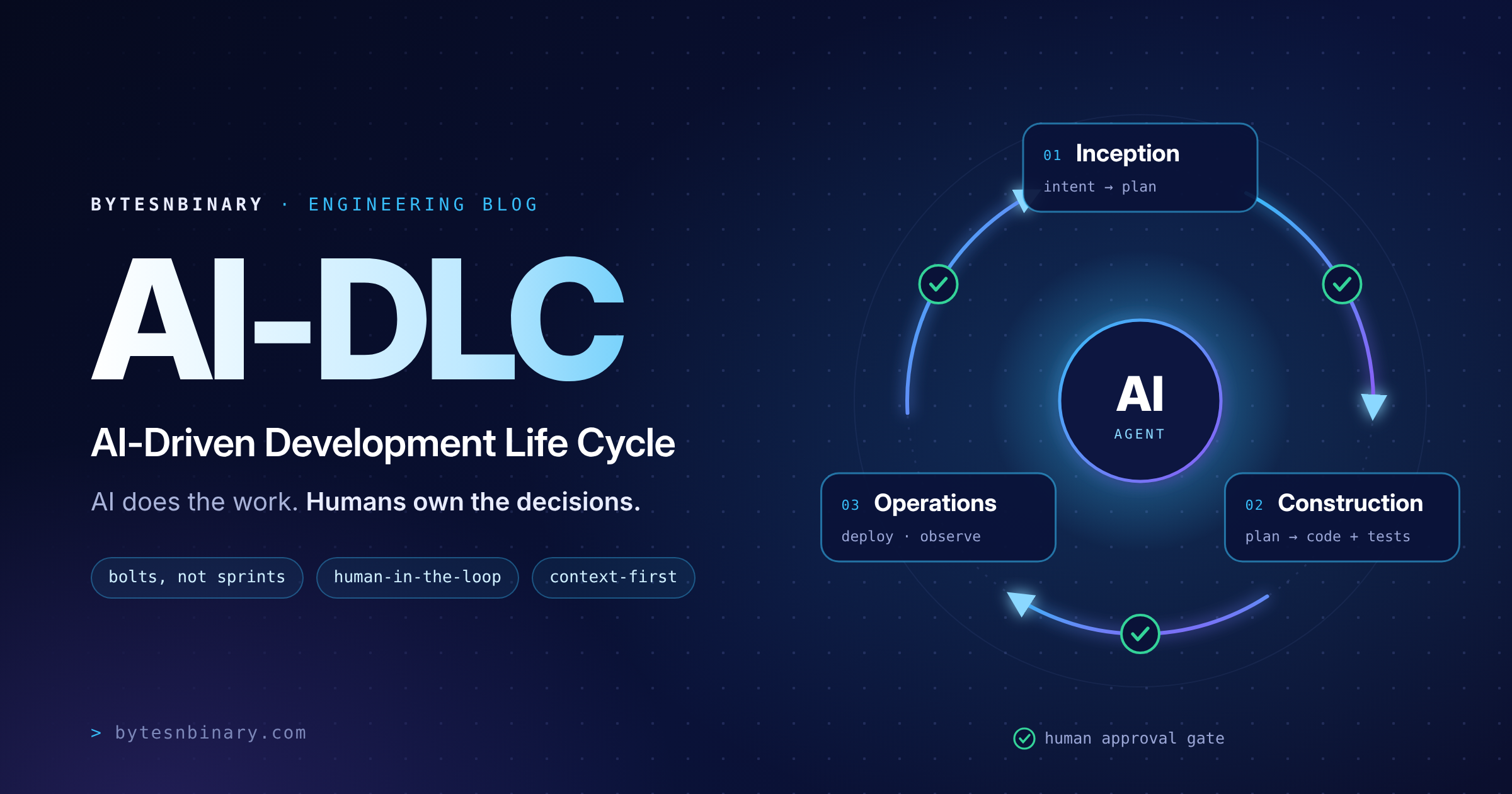
AI-DLC stands for AI-Driven Development Life Cycle. It is an emerging approach to software engineering that places AI at the centre of the development workflow rather than limiting its use to individual tasks such as code completion or documentation generation. In an AI-DLC approach, AI systems can help teams understand requirements, explore possible designs, break down work, generate implementation plans, write code, create tests, and support operational activities. Human professionals continue to provide business context, technical direction, validation, and approval at important decision points. One framework associated with this approach, introduced by AWS, organizes the process into three major phases: Inception, Construction, and Operations. The objective is to create a more continuous and collaborative development workflow in which people and AI systems work together. AI-DLC should not be viewed as a universally adopted replacement for SDLC. It is an evolving methodology that builds on established software engineering practices while expanding the role of AI across the development lifecycle. Businesses exploring this approach can also learn about AI Software Development Services to understand how AI capabilities can be integrated into modern software solutions.
4. AI-DLC vs SDLC: Key Differences
The primary difference between traditional SDLC and AI-DLC is how work is organized and how responsibilities are shared between people and AI systems. In conventional SDLC workflows, teams typically perform most analysis, planning, implementation, and validation activities manually, with automation supporting selected tasks. In AI-DLC, AI can actively participate across multiple stages by interpreting context, proposing solutions, generating implementation artifacts, and assisting with validation. **Traditional SDLC:** - Human-led requirements gathering and analysis. - Architecture and design primarily created by technical teams. - Code written and reviewed mainly by developers. - Testing scenarios and test cases largely prepared by QA teams. - Documentation maintained through dedicated activities. - Automation commonly applied to selected development and deployment tasks. **AI-DLC:** - AI assists with requirement interpretation and clarification. - AI supports architecture exploration and technical planning. - AI agents can generate code and implementation artifacts. - AI can assist in creating and executing tests. - Documentation can be generated and updated as part of the workflow. - AI and automation can support continuous development and operational feedback. AI-DLC does not remove the need for engineering discipline. Human review, testing, security controls, and accountability remain essential. The difference is that AI becomes a more active participant throughout the process.
5. The Three Core Phases of AI-DLC
The AI-DLC framework associated with AWS describes three major phases: Inception, Construction, and Operations. Each phase has a different purpose, but they work together as part of a continuous development cycle. **1. Inception:** The team establishes the business context, understands requirements, explores solutions, and prepares the work for implementation. **2. Construction:** The solution is built through implementation activities such as coding, integration, testing, and validation. AI can assist with generating and refining development artifacts. **3. Operations:** The application is deployed, monitored, maintained, and improved using feedback from real-world usage and operational data. Unlike a rigid sequence in which every activity must be completed once, these phases can involve iterative collaboration. Feedback from implementation and operations can lead to changes in requirements, design, and future development work.
6. Phase One: Inception – From Business Ideas to Clear Requirements
Inception is the phase where teams establish what needs to be built and why. It focuses on understanding the business problem, identifying stakeholders, exploring requirements, and defining the direction of the solution. In a traditional project, this work often involves meetings, workshops, business requirement documents, user stories, technical discussions, and architecture sessions. AI can support this process by analyzing business inputs, summarizing discussions, identifying missing information, suggesting follow-up questions, and organizing requirements into structured artifacts. For example, imagine a business planning to build an appointment booking application. Stakeholders may initially describe the requirement as: 'We need an application where customers can book appointments online.' An AI-assisted workflow can help expand this into possible user roles, booking rules, availability management, cancellation policies, notifications, payment requirements, and administrative capabilities. The team must still validate these suggestions with stakeholders. AI-generated requirements should be treated as drafts, not confirmed business decisions. The Inception phase may involve: - Understanding the business problem and expected outcomes. - Identifying stakeholders and user groups. - Gathering and organizing requirements. - Identifying functional and non-functional requirements. - Exploring technical feasibility and architecture options. - Breaking larger requirements into manageable units of work. - Identifying assumptions, dependencies, and risks. The result is a clearer, more structured foundation for development.
7. Phase Two: Construction – Building Software with AI Collaboration
Construction is where the planned solution is transformed into working software. This phase includes implementation, integration, testing, and validation. In traditional development, developers interpret requirements, write code, create supporting components, and collaborate with QA engineers to verify the results. AI-DLC expands this process by allowing AI systems to assist with multiple development activities while engineers retain responsibility for technical decisions and code quality. AI tools can help generate code, explain unfamiliar codebases, suggest refactoring opportunities, create unit tests, identify potential defects, and prepare documentation. In more advanced workflows, AI agents may work on clearly defined tasks using project context, development tools, and controlled permissions. For example, when building an appointment booking application, AI may assist with creating the appointment API, validating booking conflicts, generating database models, preparing test cases, and identifying edge cases. Developers review the generated implementation, verify business rules, and ensure that the solution follows the intended architecture. Construction activities may include: - Breaking requirements into implementation tasks. - Generating technical plans and code changes. - Building frontend and backend components. - Creating API integrations and database operations. - Generating and executing test cases. - Reviewing code and resolving defects. - Validating the completed functionality against requirements. AI can accelerate implementation, but generated code must still pass code review, automated tests, security checks, and functional validation.
8. Phase Three: Operations – Monitoring and Continuous Improvement
Operations focuses on running the application reliably after deployment. It includes infrastructure management, application monitoring, incident response, security updates, performance optimization, and ongoing maintenance. In an AI-DLC workflow, AI can assist with interpreting logs, identifying unusual patterns, summarizing incidents, suggesting possible causes, and supporting operational troubleshooting. AI systems may also help teams analyze user feedback and identify opportunities for future improvements. For example, if an appointment booking application experiences a sudden increase in failed bookings, monitoring systems may detect the issue and AI-assisted analysis may help correlate errors with a recent deployment, API failure, or database performance problem. Engineers investigate the evidence, decide on the appropriate response, and approve any corrective action. Operations activities may include: - Deployment and release management. - Infrastructure and application monitoring. - Log analysis and incident investigation. - Performance and availability optimization. - Security monitoring and vulnerability management. - User feedback analysis. - Maintenance planning and continuous improvement. AI-assisted operational workflows can be supported by reliable infrastructure and cloud platforms. Businesses can explore Cloud Solutions to understand how cloud architecture, containers, Kubernetes, and CI/CD practices support scalable application operations.
9. Understanding Mob Elaboration and Mob Construction
Some AI-DLC implementations describe collaborative working patterns such as Mob Elaboration and Mob Construction. These terms are associated with particular AI-DLC approaches and should not be treated as universal terminology across every software development methodology. **Mob Elaboration:** This is a collaborative activity in which people and AI work together to explore requirements, clarify business intent, identify constraints, and prepare a shared understanding of the work. Instead of relying only on one person to interpret a requirement, the team can use AI to explore alternatives, identify gaps, and organize the resulting information. **Mob Construction:** This focuses on collaborative implementation. Developers and AI systems work together to translate the agreed requirements and plans into working software. AI can assist with code generation, test creation, implementation analysis, and other development tasks while engineers review and guide the work. The central idea behind these practices is shared context and collaboration. AI should not independently decide what the business needs or approve its own implementation. The team remains responsible for the quality and correctness of the outcome.
10. Important AI-DLC Concepts and Terminologies
As teams explore AI-driven development workflows, they may encounter several concepts used to organize work and manage AI collaboration. The exact terminology can vary between frameworks and implementations. **Units of Work:** Clearly defined pieces of development activity that can be planned, assigned, implemented, and validated. A unit of work should have a clear objective, relevant context, constraints, and expected outcome. **Bolts:** In some AI-DLC descriptions, Bolts refer to smaller, focused work items or development increments. Their meaning and usage depend on the particular framework being followed. **Persistent Context:** The project information that AI systems need to work consistently across tasks. This may include requirements, architecture decisions, coding standards, existing code, technical documentation, and relevant constraints. **AI Agents:** AI-powered systems that can reason through tasks, use approved tools, and perform multi-step activities. Their permissions should be limited to the work they are authorized to perform. **Human Approval Gates:** Checkpoints where people review and approve important actions, such as architecture changes, production deployments, access changes, or sensitive data operations. These concepts help teams organize AI-assisted work while maintaining traceability, consistency, and human accountability.
11. AI-DLC vs AI-Assisted Development: Are They the Same?
AI-assisted development and AI-DLC are related, but they are not identical. AI-assisted development generally means using AI tools to support selected activities within an existing software development process. For example, a developer may use an AI coding assistant to generate a function, explain an error, or create a unit test while the rest of the project continues to follow its established SDLC workflow. AI-DLC takes a broader view. It aims to integrate AI into the development lifecycle itself, including requirement exploration, planning, implementation, validation, and operations. The focus is not only on helping individual developers complete tasks faster, but also on changing how teams coordinate work and manage development activities. **AI-assisted development examples:** - Code completion and suggestions. - Generating individual functions. - Explaining code and debugging errors. - Creating test cases from existing code. - Drafting technical documentation. **AI-DLC examples:** - AI-supported requirement analysis and elaboration. - Context-aware task planning. - AI-assisted implementation across connected work items. - Coordinated testing and validation activities. - Operational feedback informing future development. A team can adopt AI-assisted tools without changing its development methodology. Moving towards AI-DLC generally requires broader changes to workflows, context management, governance, and team responsibilities.
12. How AI-DLC Changes the Roles of Developers, Business Analysts, QA Engineers, and Project Managers
AI-DLC changes how software teams perform their work, but it does not make professional expertise unnecessary. Instead, it can shift more attention towards problem-solving, validation, decision-making, and collaboration. **Developers:** Developers may spend less time on repetitive code creation and more time reviewing generated code, designing systems, resolving complex problems, improving architecture, and ensuring maintainability. **Business Analysts:** Business analysts can use AI to organize stakeholder discussions, identify requirement gaps, draft user stories, explore edge cases, and maintain requirement traceability. They remain responsible for confirming business intent and resolving ambiguity with stakeholders. **QA Engineers:** QA professionals can use AI to generate test ideas, prepare test data, identify edge cases, and analyze test failures. Their expertise remains essential for risk-based testing, exploratory testing, quality strategy, and validating actual business behaviour. **Project Managers:** Project managers can use AI to summarize project updates, identify dependencies, prepare status reports, and support risk analysis. They continue to manage priorities, stakeholder expectations, delivery decisions, and team coordination. **Architects and Technical Leads:** These professionals can use AI to explore architecture options and review technical trade-offs while retaining responsibility for system design, security, scalability, and long-term technical direction. The goal is not to eliminate roles. It is to help professionals focus on higher-value decisions while AI supports repetitive and information-heavy activities. Teams building web and mobile products can also explore Mobile App Development as an example of how modern application engineering brings together product, design, development, and testing expertise.
13. Real-World Example: Building an Appointment Booking Application Using AI-DLC
Consider a healthcare business that wants to build an appointment booking application for patients and administrators. The application should allow patients to find available appointments, book or cancel slots, receive notifications, and manage their booking history. **Inception:** The team discusses business goals and user needs. AI assists in organizing requirements, identifying missing details, and preparing user stories. The business analyst validates booking rules, cancellation policies, user permissions, and notification requirements with stakeholders. **Construction:** The team prepares the architecture and divides the work into manageable tasks. AI assists developers with API implementation, database models, frontend components, and test case generation. Developers review the generated code, while QA engineers validate booking workflows, access control, and error handling. **Operations:** The application is deployed to a production environment. Monitoring tools track performance, availability, and errors. AI-assisted analysis can help investigate unusual booking failures or identify recurring user issues. Engineers review the findings and plan improvements. This example demonstrates how AI can contribute across the development lifecycle. It does not mean that an AI system can independently understand every business rule, make all architecture decisions, or guarantee a production-ready application. Successful delivery still depends on stakeholder participation, engineering expertise, testing, and governance.
14. Tools and Technologies That Support AI-Driven Development
AI-DLC is an approach to organizing software development, not a single software product. Different tools can support different parts of the workflow, depending on the team's technology stack, security requirements, and engineering practices. **AI Coding Assistants:** Tools such as GitHub Copilot, Amazon Q Developer, and Claude Code can assist with code generation, code explanation, debugging, and development tasks. **AI-Powered Development Environments:** Tools such as Kiro support specification-driven development workflows and can help teams structure requirements and implementation activities. **Version Control and Collaboration:** Platforms such as GitHub help teams manage source code, pull requests, reviews, issues, and collaboration. **CI/CD and Automation:** GitHub Actions and similar automation platforms can support build, test, and deployment pipelines. **Testing Tools:** Automated testing frameworks can be combined with AI-assisted test generation and analysis to improve test coverage and feedback. **Cloud and Infrastructure Platforms:** Cloud platforms and infrastructure tools provide environments for deploying, scaling, monitoring, and maintaining applications. The right combination depends on the project. Teams should evaluate tools based on data privacy, integration capabilities, access controls, auditability, cost, reliability, and the quality of their outputs. AI tools should complement established engineering practices rather than replace source control, code review, automated testing, and secure deployment processes.
15. Key Benefits of AI-DLC for Businesses and Development Teams
AI-DLC can offer several potential benefits when implemented with suitable processes, tools, and human oversight. **1. Faster Development Activities:** AI can help generate drafts, code, tests, and documentation, reducing the time spent on some repetitive tasks. **2. Improved Requirement Clarity:** AI can help identify ambiguity, missing scenarios, and inconsistencies in requirement documents. **3. Better Knowledge Accessibility:** Context-aware AI systems can help developers understand unfamiliar codebases and locate relevant technical information. **4. More Testing Support:** AI can assist with test generation, edge-case exploration, and analysis of test failures. **5. Improved Documentation Workflows:** Teams can use AI to draft and update technical documentation alongside development activities. **6. Faster Feedback Cycles:** AI-assisted analysis can help teams review implementation and operational feedback more quickly. **7. Better Collaboration:** Shared context and structured work items can help business and technical teams communicate more effectively. **8. Support for Continuous Improvement:** Operational insights can inform future development priorities and product improvements. These benefits are not automatic. Results depend on the quality of project context, the maturity of engineering practices, tool selection, and the ability of teams to validate AI-generated outputs.
16. Challenges and Risks of Adopting AI-DLC
Although AI-DLC introduces new opportunities, organizations should understand its limitations before adopting it across critical projects. **Incorrect or Incomplete Outputs:** AI can misunderstand requirements, generate incorrect code, or overlook important edge cases. **Insufficient Project Context:** AI systems may produce unreliable suggestions when they lack access to accurate requirements, architecture information, or relevant code. **Security and Privacy Concerns:** Sharing source code, customer information, credentials, or confidential business data with AI tools can create security and compliance risks. **Integration Complexity:** Connecting AI tools with source control, project management platforms, testing systems, and deployment pipelines requires careful planning. **Overdependence on AI:** Teams may accept generated outputs without adequate review, increasing the risk of defects and technical debt. **Cost Management:** AI usage can introduce additional costs through subscriptions, model usage, infrastructure, and integration work. **Skill and Process Changes:** Teams need training and clear guidelines to use AI effectively while maintaining engineering standards. Organizations should introduce AI-DLC gradually, define acceptable use policies, measure outcomes, and maintain clear ownership of all software changes.
17. Security, Quality Assurance, and Human Oversight in AI-DLC
Security and quality must remain central to any AI-driven development process. AI-generated code can contain vulnerabilities, insecure dependencies, incorrect access controls, or flawed business logic. AI-generated test cases can also miss important scenarios or create a false sense of confidence. A responsible AI-DLC implementation should include: - Human review of generated code and architecture changes. - Secure handling of source code, credentials, and sensitive information. - Role-based access controls for AI tools and agents. - Automated code scanning and dependency vulnerability checks. - Unit, integration, regression, and end-to-end testing. - Clear approval requirements for production deployments. - Audit logs for AI-assisted actions and changes. - Traceability between requirements, implementation, and test results. - Monitoring and incident response procedures after deployment. AI agents should operate with the minimum permissions required for their tasks. Actions that can affect production systems, customer data, financial transactions, or security settings should have appropriate safeguards and human approval. AI can support quality and security activities, but it cannot replace a well-designed engineering governance process.
18. AI-DLC vs Agile: Are They Competing Methodologies?
AI-DLC and Agile address different aspects of software development. Agile is a family of approaches focused on iterative delivery, collaboration, adaptability, and continuous feedback. AI-DLC focuses on integrating AI into software engineering activities across the development lifecycle. Agile teams commonly organize work into iterations or sprints, maintain product backlogs, conduct planning sessions, and review delivered increments. An AI-DLC-oriented team can use AI to support requirement elaboration, task breakdown, implementation, testing, and operational analysis within an Agile delivery model. For example, an Agile team may continue to plan work in two-week sprints while using AI tools to draft user stories, generate test scenarios, assist with implementation, and summarize sprint progress. The team's ceremonies, prioritization, and accountability can remain in place. Therefore, AI-DLC does not necessarily replace Agile. Organizations can combine AI-driven workflows with Agile, Scrum, or other delivery approaches, provided responsibilities, review processes, and quality controls remain clear.
19. When Should Businesses Consider Adopting AI-DLC?
AI-DLC may be worth exploring when an organization wants to improve development workflows and has the technical and organizational readiness to use AI responsibly. It may be particularly relevant for businesses that: - Maintain large or complex software projects. - Have repetitive development and documentation activities. - Want to improve requirement analysis and knowledge sharing. - Need faster feedback between development and testing. - Are already using AI coding or testing tools. - Have established source control, CI/CD, and code review practices. - Can define clear security and governance policies. AI-DLC may be harder to introduce in environments where requirements are poorly understood, source code and documentation are inconsistent, or security policies do not permit the use of external AI services. In such cases, improving engineering fundamentals should come first. Businesses should begin with a limited pilot project, select measurable objectives, and evaluate the results before expanding AI-driven workflows across the organization.
20. How to Transition from Traditional SDLC to AI-DLC
Moving towards AI-DLC does not require an organization to abandon its existing development process immediately. A gradual transition allows teams to evaluate AI capabilities while maintaining delivery stability. **Step 1: Review Existing Workflows:** Identify repetitive activities, delivery bottlenecks, documentation gaps, and areas where teams spend significant time transferring information. **Step 2: Identify Suitable AI Use Cases:** Start with lower-risk activities such as requirement summarization, documentation drafts, code explanation, or test case suggestions. **Step 3: Improve Project Context:** Organize requirements, architecture documents, coding standards, and technical knowledge so AI tools can work with relevant and reliable information. **Step 4: Select Appropriate Tools:** Evaluate AI tools based on security, privacy, integration, cost, and compatibility with existing workflows. **Step 5: Define Governance Rules:** Establish guidelines for data sharing, AI permissions, code review, testing, and approval of sensitive actions. **Step 6: Train the Team:** Help developers, business analysts, QA engineers, architects, and project managers understand how to use AI effectively. **Step 7: Run a Pilot:** Introduce AI into a limited project or workflow and measure quality, time savings, cost, and team feedback. **Step 8: Improve and Expand:** Use the results to refine the process before introducing AI-driven practices across additional projects. A structured transition can be part of a broader Digital Transformation Services initiative, helping businesses align technology adoption with their operational and strategic goals.
21. The Future of Software Development: What Comes After Traditional SDLC?
Software development is likely to become increasingly collaborative as AI systems improve their ability to understand context, use development tools, and support multi-step engineering tasks. Future workflows may involve specialized AI agents assisting with requirements, architecture analysis, coding, testing, security reviews, and operational monitoring. However, the future is unlikely to be defined by AI working without human involvement. Business understanding, system architecture, ethical decisions, security accountability, and product direction require careful human judgment. Organizations will need to determine which activities can be delegated to AI, which require human approval, and how every change can be traced and validated. The development teams that benefit most may be those that combine strong engineering fundamentals with effective AI adoption. They will need reliable project context, clear workflows, secure tool integration, and a culture of continuous learning. AI-DLC represents one direction in the evolution of software engineering. As the approach matures, businesses may develop their own versions of AI-driven workflows suited to their products, teams, and governance requirements. Companies looking to build differentiated digital products can also explore Bespoke UI/UX Design Solutions to create experiences that align with their users and business needs.
22. Frequently Asked Questions About AI-DLC
**1. What does AI-DLC stand for?** AI-DLC stands for AI-Driven Development Life Cycle. It describes an approach to software engineering that integrates AI into activities across the development lifecycle. **2. What is the difference between AI-DLC and SDLC?** Traditional SDLC is generally organized around human-led development activities supported by tools and automation. AI-DLC gives AI a more active role in requirement analysis, planning, implementation, testing, and operations while people retain responsibility for decisions and validation. **3. What are the three phases of AI-DLC?** The AWS-associated AI-DLC framework describes three main phases: Inception, Construction, and Operations. **4. Does AI-DLC replace SDLC?** No. AI-DLC is an evolving approach that builds on software development lifecycle practices. It should not be considered a universal replacement for SDLC. **5. Is AI-DLC the same as AI-assisted coding?** No. AI-assisted coding focuses mainly on using AI for individual development tasks. AI-DLC takes a broader approach by integrating AI into multiple activities across the software development lifecycle. **6. Can AI-DLC work with Agile or Scrum?** Yes. AI-driven workflows can be used within Agile or Scrum teams. AI can support planning, requirement analysis, development, testing, and reporting while existing delivery practices continue. **7. Will AI-DLC eliminate developers or business analysts?** No. AI can automate or assist with selected tasks, but organizations still need professionals to understand business needs, make technical decisions, validate outputs, manage risks, and maintain software. **8. What tools are used in AI-DLC?** Teams may use AI coding assistants, AI-powered development environments, version control platforms, testing frameworks, CI/CD tools, and cloud infrastructure services. The exact tools depend on the organization's requirements and technology stack. **9. Is AI-DLC suitable for small businesses and startups?** It can be useful for smaller teams, particularly when AI helps reduce repetitive work. However, teams should choose tools carefully, protect sensitive information, and maintain proper testing and review practices. **10. What are the biggest risks of AI-DLC?** Important risks include incorrect AI-generated outputs, security and privacy issues, insufficient project context, overdependence on AI, integration complexity, and additional costs. Human oversight and engineering controls are essential.
Conclusion
The evolution from SDLC to AI-DLC reflects a broader change in how software is planned, built, tested, and maintained. Traditional SDLC provides the structure and discipline that software engineering depends on, while AI-DLC explores how AI can participate more actively across the entire development process. Its Inception, Construction, and Operations phases offer a way to think about continuous collaboration between people and AI systems. However, adopting AI does not remove the need for strong requirements, sound architecture, secure coding, comprehensive testing, and accountable decision-making. Businesses should approach AI-DLC as an opportunity to improve their development workflows, not as a shortcut around engineering fundamentals. The most effective approach will combine AI capabilities with human expertise, reliable processes, and continuous validation.