
AI Building the Next AI: The Rise of Recursive Self-Improving Intelligence in 2026
Introduction
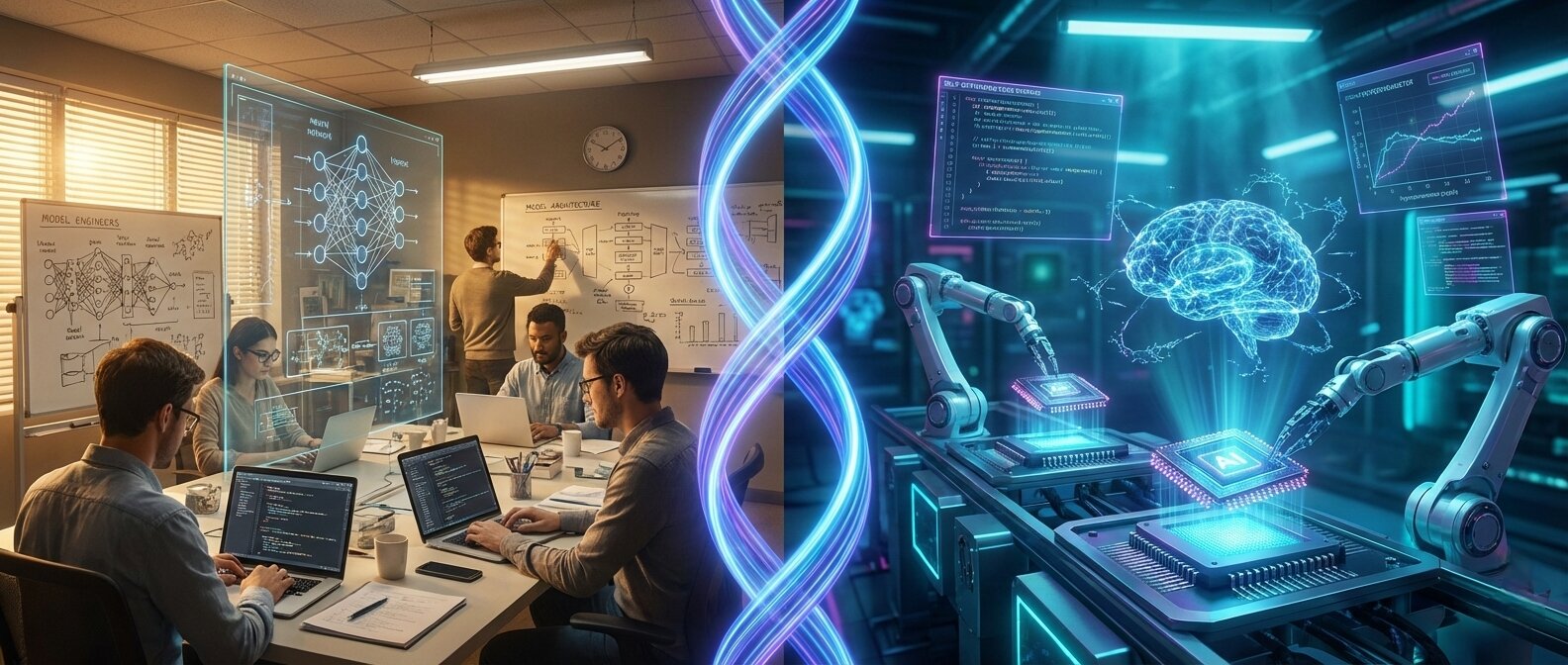
Artificial intelligence has entered a new phase. For years, humans built and improved AI systems manually. Engineers designed models, optimized algorithms, and trained systems using human-written code and architectures. But in 2026, a major shift is happening: AI is now helping build the next generation of AI. From writing code to optimizing models and designing chips, AI systems are increasingly involved in creating more advanced AI. This phenomenon is known as recursive self-improvement, and it is accelerating innovation across industries. This blog explains what “AI building the next AI” really means, why it matters, and how businesses should prepare for this rapidly evolving future.
How AI Development Worked Traditionally
Traditionally, AI development followed a human-driven process. Humans designed models, optimized training, wrote code, and improved performance manually. While this approach led to major breakthroughs, it was limited by human speed and capacity. AI progress depended entirely on manual experimentation and engineering cycles.
What Is Changing in 2026?
Today, AI systems are starting to assist in building better AI systems. AI now helps design architectures, write code, optimize hyperparameters, design hardware, and discover algorithms. This marks the beginning of a new development cycle where AI accelerates its own evolution and improves future AI systems faster than ever before.
What Is Recursive Self-Improvement?
Recursive self-improvement refers to a cycle where AI systems help create smarter versions of themselves. Each generation of AI builds better models, improves efficiency, enhances performance, and reduces development time. The result is a feedback loop where innovation accelerates rapidly. Instead of waiting years for breakthroughs, advancements can happen in months or weeks.
Why This Matters for Businesses
This shift is not just technical—it has major business implications. Faster innovation: AI tools speed up development timelines. Lower development costs: Automation reduces manual engineering work. Better products: AI-optimized systems perform more efficiently. Competitive advantage: Companies adopting AI-driven development move faster. Businesses that embrace AI-assisted development will innovate faster than competitors.
Opportunities Created by AI-Built AI
Faster product development: Companies can launch AI products more quickly. Scalable automation: AI systems can handle complex workflows. Smarter decision-making: AI improves analytics and forecasting. New business models: AI-native companies are emerging. This creates opportunities for startups and enterprises alike.
Risks and Challenges
Despite its potential, recursive AI improvement introduces challenges. Security concerns: AI-generated code must be reviewed carefully. Quality control: Human oversight is still necessary. Ethical considerations: Responsible AI development is critical. Dependency risks: Over-reliance on AI tools can create vulnerabilities. A balanced approach combining AI speed with human expertise is essential.
How BytesNBinary Approaches AI-Driven Development
At BytesNBinary, we combine AI-assisted development with strong engineering practices. Our approach includes AI-accelerated development workflows, architecture-first design, secure coding practices, human review and testing, and scalable system design. Organizations looking to build advanced AI systems often collaborate with AI software development companies to design intelligent solutions. We use AI to improve speed and efficiency while maintaining reliability, security, and performance.
Conclusion
The idea of AI building the next generation of AI is no longer science fiction—it’s happening now. Recursive self-improvement is accelerating innovation and transforming how software is built. However, AI still requires human expertise, oversight, and responsible implementation. The future of development lies in combining AI speed with strong engineering practices. Organizations that adopt AI-assisted development responsibly will lead the next wave of digital transformation.